


How to Conduct a Knowledge Management Assessment?

Written by: Shushmmitha (Technical Content Writer)
Reviewed by: Sid (Industry Specialist)
Inside the article
Key Takeaways
- A Knowledge Management (KM) assessment evaluates an organization’s current knowledge state, identifies gaps, and highlights areas for improvement.
- Organizations conduct knowledge management assessments either before or after implementing knowledge management practices.
- It examines key areas such as people, processes, strategy, content, technology, and governance.
- The steps for knowledge management assessments include defining goals, engaging stakeholders, reviewing existing knowledge, gathering feedback, evaluating knowledge management capabilities, and delivering a report.
- You can measure the outcome of the assessment by tracking key performance indicators.
Summarise this blog for me
Too busy to read the full article? Get a quick summary in your preferred AI tool.
What is a knowledge management assessment?
A knowledge management assessment examines the effectiveness of current knowledge management practices across the organization. The outcome focuses on identifying key areas to close knowledge gaps where knowledge management initiatives are lacking. This helps the organization enhance its KM practices and stay competent and up to date.
Why and when should you conduct a knowledge management assessment?
The answer is simple: organizations must conduct a knowledge management assessment before or after implementing KM strategies or practices to track their effectiveness.
Conducting the assessment before implementing KM practices helps identify current knowledge gaps; conducting it after implementation evaluates the qualitative and quantitative results of the applied KM strategies.
For example, Texas Instruments conducted an assessment on best practices in knowledge management across its semiconductor manufacturing plants to identify performance gaps and evaluate successful practices. The initiative aimed to reduce performance variations between plants by sharing and implementing proven practices, improving operational efficiency, and avoiding unnecessary investments.
What areas should a knowledge management assessment cover?
People & culture
People are the pillars of the organization; they play a vital role in shaping and sustaining its knowledge landscape. During the knowledge management assessment, the organization evaluates its people's ability to adapt to emerging knowledge trends and support a learning culture. This can drive knowledge sharing and foster a collaborative work environment.
Strategy & alignment
During the knowledge management assessment, the effectiveness of the current knowledge management strategy is evaluated by examining how well it aligns with day-to-day operational workflows.
This is done by ensuring the right knowledge resources reach the right people, determining whether the current strategy needs tweaks or alternatives, and prioritizing end goals.
Processes & lifecycle
As a core part of the assessment, it tracks how knowledge is used at each step of a process. It can be checked by examining how knowledge is used to achieve, manage, and improve a particular task within the process, contributing to the organization’s end goal.
The knowledge lifecycle is also assessed by evaluating how long knowledge needs to be preserved and when it should be retired.
Content & structure
In the knowledge management assessment process, the organization reviews the documented content and structure of existing knowledge. In this process, pre-existing knowledge recorded in forms such as knowledge base articles is evaluated by checking the publication date, review status, and owners to ensure it stays up to date with current organizational needs.
Technology & infrastructure
Since technology automates manual workflows, it is important to assess the ability to adapt to technology. During the knowledge assessment process, the ability to adapt to technology-based knowledge solutions, such as knowledge base software, content management systems, and other collaborative tools, is investigated. It helps simplify complex tasks, reduce complexity, and drive workplace digital transformation.
Governance & security
During the knowledge management assessment, the organization is checked to see whether it remains compliant with governance requirements. It also verifies how effectively the organization maintains information security and confidentiality. As a result, it ensures knowledge is securely preserved.
What organizations discover through KM assessments
Bank Negara Indonesia (BNI) is one of the best-known banks in the Indonesian banking Industry. It has begun adapting to digital channels and digitizing its activities. But over time, it began to face customer satisfaction issues. This was due to a lack of proper knowledge management practices within the IT testing and quality assurance teams.
To address this, the organization conducted a knowledge assessment using the APO knowledge management assessment tool, which assessed areas such as KM Leadership, processes, people, technology, learning and innovation, and KM outcomes. As a result, the organization obtained a baseline score of 160.67. To strengthen knowledge management practices, the organisation adopted the SECI model and improved performance.
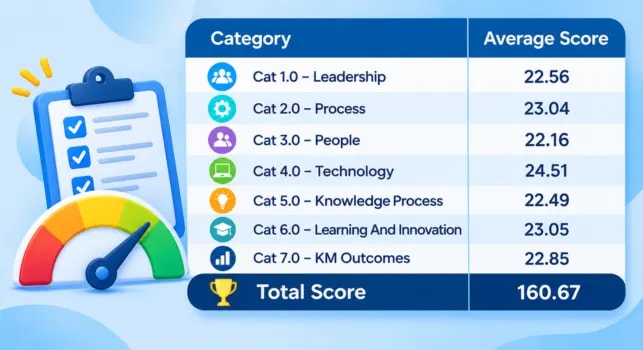
Outcome of the knowledge management assessment
Steps to conduct a knowledge management assessment
Step 1: Define assessment goals and scope
Predefine the goals, objectives, and expected outcomes of conducting the knowledge management assessment. For instance, set the goal based on the assessment's purpose, whether to understand the current knowledge status, identify knowledge gaps, or estimate the results of implementing KM practices.
Step 2: Involve key stakeholders
Make the key stakeholders part of the knowledge management assessment. Include both the internal and external stakeholders. Consider assessing the knowledge gained by internal employees and external customers. This can help the assessment identify knowledge gaps from both perspectives: as a product or service provider and as a user.
Step 3: Review existing knowledge and knowledge management systems
Reviewing existing knowledge repositories and technology systems helps organizations understand where information is hidden and why employees find it difficult to access.
Learn more about a knowledge management system and what happens without one.
Example of how an organization enacts this step
For example, an automotive manufacturing company found that employees widely rely on personal networks to find technical specifications, design documents, and previous project information. This was found during an assessment of more than 100 employees.
From this example, we can infer that the company lacked a centralized repository for all its knowledge sources, increasing its dependence on personal networks. This clearly shows the current state of knowledge organization and the need for a knowledge management system.
Step 4: Gather feedback and identify knowledge gaps
Gather feedback to uncover hidden knowledge gaps. While collecting feedback on their current knowledge state, be sure to ask about their role and the nature of their work. Employees may hesitate to disclose their knowledge gaps in particular areas. This can help surface hidden problems and gaps employees face.
Step 5: Evaluate Knowledge management capabilities and maturity
Evaluating knowledge management capabilities means analyzing the capacity of the organization’s teams to follow knowledge management practices. It also assesses how well the curated practices fit the current workflow and whether they deliver improvements.
If knowledge management practices are well executed, we can infer that the organization’s knowledge maturity is on track, as practices such as capturing, storing, organizing, managing, and accessing information are being carried out as expected.
Step 6: Deliver the assessment report and action roadmap
After conducting the knowledge management assessment, summarize the final report, showing how much each core area discussed in the above section scores. Next, design a roadmap to address the areas that lag in the final report and curate insights for future development. Simply plan actions to accomplish as part of improving the ongoing knowledge management practices.
Knowledge management assessment questions
- Do your organizational teams follow a clear knowledge management strategy that supports their business goals?
- Is it easy for employees to find the information they need to do their jobs each day?
- Are our knowledge repositories well-organized and updated regularly so that the information stays relevant?
- Do employees get support to share what they learned from both successful and unsuccessful projects?
- Are employees open to sharing knowledge with colleagues from other teams or departments?
- Do we ensure that we document and retain important knowledge when employees leave or change roles?
- Can employees easily find and reach subject-matter experts when they need help?
How to measure knowledge management assessment results
Knowledge management assessment results can be measured by tracking the key performance indicators:
- Knowledge accessibility: This measures how easily employees can access the information they need, rather than spending hours searching for it.
- Knowledge retention: This shows how much the organization prioritizes recording critical knowledge before veterans leave and how much employees contribute to preserving the organizational knowledge landscape.
- Knowledge sharing rate: This rate shows how often employees share knowledge, making it a necessary part of day-to-day work.
- Employee productivity: Employee productivity reflects the actual effectiveness and real-time changes in the work environment resulting from KM practices or, by default, the rate at which employees complete their tasks over a given period.
- Knowledge reuse: It shows how efficiently employees share and use existing or newly uncovered knowledge to accomplish their necessary tasks.
- Customer satisfaction: It shows increases in customer satisfaction, contributing to overall business profit.
Get instant answers from your documents
Conclusion
A well-planned knowledge management assessment acts as a compass needle, pointing to knowledge gaps. Once gaps are identified, the organization must decide how to close them. It can no longer be treated as optional; it must be considered an essential part of organizational workflow.
I hope this blog has given you useful insights into the purpose of a knowledge management assessment, the key areas to cover, the steps to follow, and the outcomes you can expect.
How we researched this article
Published research supports the statistics and claims in this article.
Statistics and claims in this article come from these sources.
Written by: Shushmmitha (Technical Content Writer)
Reviewed by: Sid (Industry Specialist)
Get instant answers from your documents
Similar blogs





See Accurez for yourself
Come with questions and meet the people behind the product.