


8 Knowledge Management Best Practices That Actually Stick

Written by: Shushmmitha (Technical Content Writer)
Reviewed by: Sid (Industry Specialist)
Inside the article
Key Takeaways
- Organizations must treat knowledge management as a valuable process that brings knowledge into everyday workflows.
- Knowledge management best practices include aligning your knowledge management plan with your organization's goals by establishing effective governance, choosing the right tool for your workflow, documenting tacit knowledge, building a knowledge-sharing culture, conducting regular content audits, tracking KPIs, and structuring the knowledge base to support AI adoption.
- Knowledge management isn't just about bringing available knowledge into a central repository; the goal is to create an environment that drives business growth.
Summarise this blog for me
Too busy to read the full article? Get a quick summary in your preferred AI tool.
Organizations create wikis, knowledge bases, procedures, and documents, but that doesn't automatically become knowledge. The real value comes from making this knowledge easily accessible and bringing it to life in the organization's workflow. To accomplish this, knowledge management is crucial. In this article, we'll look at the eight best knowledge management practices that work, not just boring advice.
1. Align knowledge management with business goals
Knowledge has become the key economic resource and the dominant-and perhaps even the only-source of competitive advantage.
According to Peter Drucker, knowledge is a key economic resource that moves you ahead of your competitors. If an organization fails to pay attention, it cripples its resources and leads to disconnected knowledge management.
The factors that cause disconnected knowledge management include:
- Information scattered across multiple systems and teams.
- Employees fail to document knowledge.
- Important tacit knowledge leaves when experienced employees leave.
- Lack of governance for knowledge management.
Disconnected knowledge management over time creates a pathway for knowledge loss. Knowledge loss depletes organizational resources by forcing teams to repeat tasks, restart from scratch, lower productivity, and make weaker decisions.
To prevent disconnected knowledge management, organizations' goals must align with the knowledge management strategies.
There are four steps to map KM with the organizational goal:
- Step 1: Find the end goal of the organization.
- Step 2: Audit whether your organization holds the necessary data, expertise, or knowledge. If you can spot the knowledge, bring it into a central repository.
- Step 3: Assign the knowledge source to each department and ensure the right people access the right knowledge resource and get the right information. At this step, inject the KM workflow directly into action.
- Step 4: Track outcomes and collect feedback for future improvements.
2. Establish governance before deploying any tool
Establish knowledge management governance before implementing a KM practice with a tool.
The governance must include structured rules on the following areas:
Knowledge ownership:
Set clear ownership for accessing the knowledge source. There are different ways to provide access to knowledge sources, such as:
- Role-Based Access Control: Access to the knowledge source is granted based on employees' roles.
- Attribute-Based Control: Access to the knowledge source is granted based on attributes such as time, geographical location, and user.
- Relationship-Based Control: Access is granted based on the employee's relationship to the knowledge source.
Fix roles for knowledge management:
Appointing a capable knowledge manager is essential to governance. Appoint knowledge owners for each team; they must take responsibility for capturing, storing, and updating knowledge in the knowledge base, and monitor knowledge flow across the organization.
Content review cycle:
The content review cycle frequency can be fixed based on content volume. Review cycles must verify that the information is factually correct, check for outdated policies, guidelines, and content relevance, and update it. During reviews, document anything you find and prevent it from happening again; this keeps the knowledge base live.
Did you know?
There are three types of knowledge governance models:
Centralized model: A single team is responsible for knowledge management.
Distributed model: Each team owns knowledge widely adopted by large enterprises.
Federated model: Combines centralized and distributed models, suitable for multi-team organizations.
A real-world warning from a Redditor:
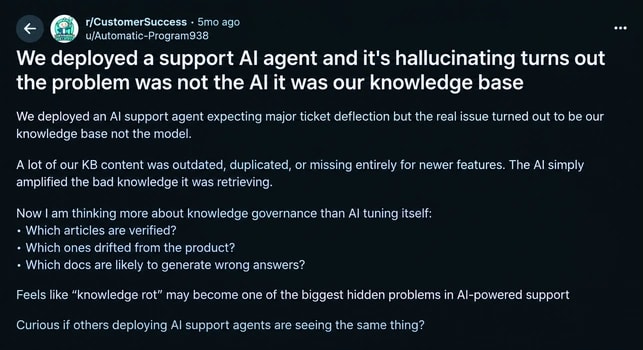
Image source: Reddit
A Redditor described their struggle and failure in deploying an AI service agent. This happened because they lacked proper knowledge base governance.
3. Choose tools that fit how people actually work
Knowledge management tools should be an integral part of the everyday workflow; they shouldn't add burden to employees. The tool doesn't need flashy features; it just needs to meet the basic requirements. Too many features can complicate navigation, create unclear processes, and discourage employees from using the tool.
One major hurdle organizations face when adopting knowledge management tools is migrating knowledge; moving large amounts of existing knowledge is difficult.
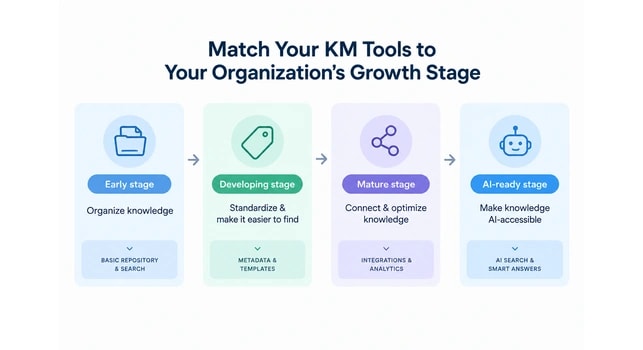
“Have you ever thought about how to match the KM tools at different phases of your organization's progress?”
The flow chart below shows what to focus on at each stage and which tool features to use.
4. Codify tacit knowledge before it walks out the door
Tacit knowledge is practical knowledge employees gain through years of experience doing their work. Unlike documented knowledge, tacit knowledge often exists in an employee's mind and is difficult to explain through manuals or written instructions.
Tacit knowledge often includes intuition and personal judgment, and it is difficult to transfer. When experienced employees retire or resign, undocumented knowledge moves with them, creating a knowledge gap in the organization.
There are four different ways to capture tacit knowledge before it walks out the door, such as:
- Document processes and workflows: Document employees' practical workflows and processes into structured procedures such as SOPs, policies, and user guides.
- Record the knowledge: Record complex tasks performed by experts. The recorded sessions serve as a knowledge source that demonstrates the task workflow in practice.
- Implement job shadowing: Pair experienced employees with new joinees to get direct mentoring, shadowing, and peer learning.
- Conduct knowledge-transfer sessions: Hold regular knowledge-transfer sessions to create a culture where everyone knows everything and nothing remains unknown.
Proof that the problem exists in practice:
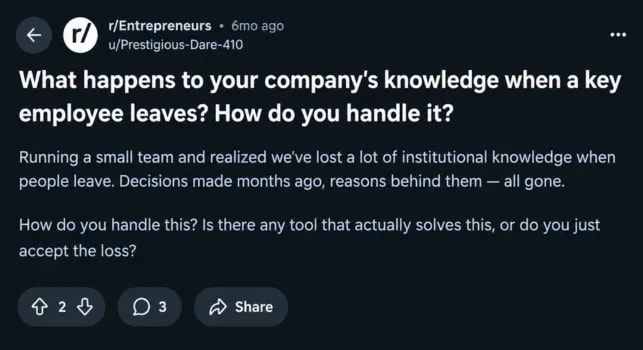
Image source: Reddit
An entrepreneur on Reddit shared that a key employee with practical knowledge left the organization.
5. Build a culture that rewards knowledge sharing
Make knowledge sharing a part of workplace culture. Employees may keep information in personal files, emails, chats, or with individual experts; encourage them to surface it and share the essential details with the team. Reward the quality of knowledge employees share, not the quantity. Highlight employees who contribute valuable knowledge in team meetings, newsletters, or internal channels.
Employees can be rewarded with awards for knowledge sharing such as:
- Encourage knowledge-sharing employees by giving contributor awards with titles like Knowledge Champion, Top Contributor, or Subject-Matter Expert of the Month.
- Provide learning opportunities that offer access to courses, certificates, conferences, and professional development programs.
- Provide small monetary rewards for particularly valuable contributions or successful knowledge-transfer initiatives.
- Give high-performing contributors opportunities to lead projects, mentor others, or participate in strategic initiatives.
- Reward teams that consistently maintain high-quality, useful, and up-to-date knowledge.
6. Audit and maintain content on a regular cadence
Regular content audits are crucial to knowledge management. During a content audit, review your knowledge base content and mark it obsolete to prevent it from becoming stale. A checklist is listed below.
Follow this checklist to maintain and keep your content up to date:
7. Measure KM impact and prove its business value
To know about the performance of knowledge management and to find its business value, track its key performance indicators such as:
KPIs to track:
- Employee involvement: Measure each employee's knowledge contribution rate, regardless of role, experience, or department.
- User engagement: Measure how long each user spends in the knowledge base and how they interact with the content, such as clicking relevant sources. This helps you understand response time and how long users take to find the right information.
- Content coverage: Analyze whether the answer is relevant to the user's question and satisfies their intent. Tracking content coverage also shows the resolution rate of the answers provided.
- User satisfaction: Track user satisfaction by providing star ratings, review sections, and survey forms at the end of each knowledge source.
- Zero-result rate: A zero-result rate is a ticking time bomb for your knowledge base; treat it as an early warning sign, identify the root cause, and add the missing knowledge source.
Once all the key performance indicators are tracked, calculate the ROI of your knowledge management. Find out how much your knowledge management plan contributes to the overall business profit. This gives you real-time insight into the economic contribution of knowledge management to the overall well-being of the organization.
Learn more about measuring knowledge management ROI and its business value.
8. Structure your knowledge base for AI before rolling out AI
Structure your knowledge base before rolling out AI. To structure your knowledge base, identify the types of knowledge sources present in your knowledge base. Also identify the file types AI can process. Then take the necessary steps to convert existing files into formats supported by AI. Since AI will play a role in retrieval, use consistent terminology, document structures, and naming conventions across the knowledge base.
Learn more about organizing your knowledge base.
How Accurez supports these knowledge management best practices
Accurez is self-hosted knowledge base software that supports effective knowledge management for your organization in the following ways:
- With Accurez, you can upload your knowledge sources in the form of text files, drive links, Notion, and public URLs.
- Users can ask questions in simple, plain language; the system uses hybrid search to retrieve answers and returns them with the right context.
- The system grounds retrieved answers with relevant source citations from the uploaded sources.
- You can assign dedicated AI knowledge assistants to provide answers from approved sources specific to each assistant.
- Since Accurez is self-hosted, your organization’s knowledge stays within your own infrastructure.
Get instant answers from your documents
Conclusion
I hope this blog has given you a different perspective on knowledge management. That goal is not simply building a knowledge repository. It is to create a reliable knowledge environment that evolves with the organization, supports everyday work, and continues to deliver value as the business grows.
How we researched this article
Published research supports the statistics and claims in this article.
Statistics and claims in this article come from these sources.
Wikipedia - https://en.wikipedia.org/wiki/Peter_Drucker
Written by: Shushmmitha (Technical Content Writer)
Reviewed by: Sid (Industry Specialist)
Get instant answers from your documents
Similar blogs



See Accurez for yourself
Come with questions and meet the people behind the product.