


10 Benefits of a Knowledge Management System Backed by Research

Written by: Shushmmitha (Technical Content Writer)
Reviewed by: Sid (Industry Specialist)
Inside the article
Key Takeaways
- A knowledge system serves as a centralized platform that brings organizational knowledge together in a single searchable system.
- KMS offers 10 practical benefits, including saving time, increasing productivity, reducing costs, improving decisions, enhancing customer support, fostering innovation, streamlining onboarding, enabling collaboration, knowledge sharing, and strengthening compliance.
- KMS helps organizations preserve organizational knowledge and acts as an intangible business asset.
Summarise this blog for me
Too busy to read the full article? Get a quick summary in your preferred AI tool.
A knowledge management system can bring organizational knowledge into a structured, searchable environment, but only if you treat it as an organizational asset, not just software. To use a knowledge management system at full efficiency, it must be an integral part of organizational activities and aligned with the organization's end goal.
In this blog, let's explore ten practical benefits we can gain by using a KMS effectively.
1. Save hours every week with instant knowledge access
Time is a valuable resource for the organization; treat it as an integral part of the organization’s outcome. According to Atlassian's State of Teams, 25% of executives and teams spend a quarter of their workweek searching for information.
Overcome this hindrance with a knowledge management system that turns hours of searching into seconds. A knowledge management system helps employees access information, documents, and existing knowledge instead of recreating it. This reduces duplicated work and saves employees time.
2. Get more done with less time wasted on searching
A knowledge management system saves time spent searching for information and on other knowledge-related tasks. The tasks include collecting, organizing, capturing, storing, and retrieving information. Retrieving the right information at the right time prevents disruptions to the organization's regular workflow and even eliminates waiting time and delays.
Time saved from searching for information can be invested in other organizational operations. For example, the time a salesperson saves retrieving product pricing information can be used to generate more leads.
3. Reduced costs and measurable ROI
An effective knowledge management system helps employees find relevant information at the right time, reducing the organization's costs in the following areas:
- Lowers labor costs: Employees spend less paid working time searching for information, which can improve their productivity.
- Let us look at a real-time illustration:
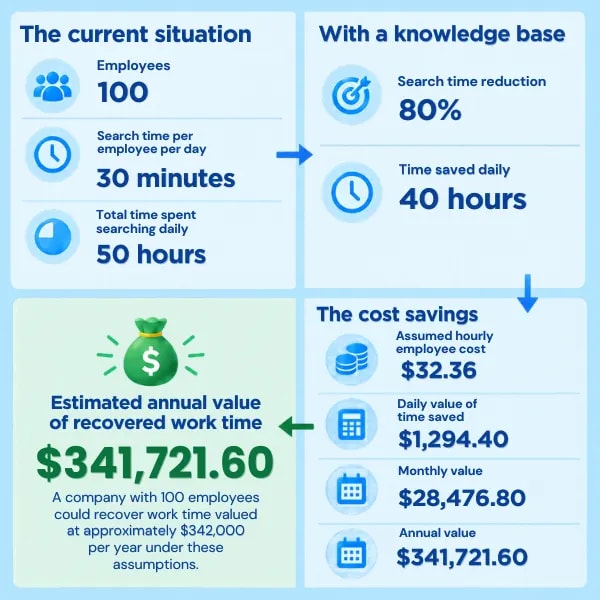
Consider a mid-size company in the US with 100 employees, where each employee spends 30 minutes each day searching for information. Let's assume a wage cost of $32.36 per employee per hour, based on the U.S. Bureau of Labor Statistics.
Now let’s calculate the annual value of the time and cost saved by implementing a knowledge management system for searching information. The image below breaks down the calculation and shows the potential cost savings.
- Let us look at a real-time illustration:
- Lower training costs: Companies can reduce training costs by giving employees a knowledge management system that lets them retrieve task workflow-related information.
- Eliminates Knowledge loss: By retrieving relevant information at the right time, it reduces ignored information and prevents knowledge loss.
Contributing to knowledge management helps reduce operational costs and improve the organization's overall ROI. Learn more about how to measure knowledge management ROI and evaluate its business value.
4. Better decision-making across the organization
Knowledge management improves decision-making by ensuring the right information reaches the right people at the right time. Decisions can be made promptly as information is easily accessible.
Better decision-making across organizations provides profound benefits such as:
- Helps achieve organizational goals: The decision-making process is key to achieving organizational goals because the right decisions act as a compass needle pointing the direction to the destination.
- Better revenue generation: The decision-making process supports revenue generation by making sound decisions in financial conflicts.
- Reduces stress: When the right information is available when needed, especially in high-pressure situations, it reduces the stress of finding information and making decisions.
- Stronger confidence: Decision makers can decide with greater confidence because their decisions are grounded in evidence.
- Improved leadership and trust: Everyone in the organization trusts the decision-maker's decisions because they are grounded in evidence, which can improve trust in their leadership.
- Increased accuracy: A reliable knowledge management system can improve decision-making speed and accuracy, reducing repeated mistakes.
Learn more about how knowledge management enhances decision-making.
5. Enhanced customer service and experience
Knowledge management improves customer service and experience by eliminating information silos and improving the information flow across the organization. This makes the information provided to customers remain consistent and credible across all channels, such as email, chat, and phone.
As a result, service agents can solve customer queries independently by reducing resolution time and responding quickly.
Overall, it increases customer satisfaction and experience by converting first-time customers into repeat customers. This positively impacts brand reputation, and loyal customers build brand awareness.
Example from the real world
Metrigy’s 2025-2026 global study found that 393 companies achieved 11.6% revenue growth, a 19.7% boost in customer ratings, and a 22.1% improvement in operational efficiency with AI-enabled knowledge management.
The numbers clearly show the deliberate impact of using knowledge management in customer experience, as shown by the boost in customer ratings and the increase in the organization's overall revenue.
6. Faster onboarding and continuous learning
Finding the right information helps employees understand their roles and responsibilities faster. During onboarding, new employees can access a knowledge management system to find training materials, company policies, and SOPs easily. This helps them adapt quickly to the organization's day-to-day workflow and culture. It also reduces new employees' dependence on senior colleagues.
A knowledge management system initiates continuous learning because employees can revisit documentation, learn new processes, and update their skills as business needs change. Instead of waiting for formal training sessions, they can learn at their own pace and apply what they learn directly to their work. Employees can learn from what has already worked instead of discovering the same approach independently.
Knowledge management in action:
A beverage packaging plant plans to replace existing employees with 30+ years of experience with new employees. The experienced employees carry all the tribal knowledge with them. New employees were trained using paper-based manuals, but the knowledge they needed was scattered across multiple resources.
As a result, the training was ineffective, and new employees lacked the skills to repair broken-down machines. The company implemented a centralized digital knowledge repository that consolidates critical knowledge from paper-based records.
This helped employees learn and solve problems more easily through a step-by-step workflow. Now, training and onboarding time is reduced by 77%, from 18 months to 4 months.
7. Innovation, agility, and competitive advantage
Knowledge management provides the foundation for innovation, agility, and competitive advantage.
Innovation:
A knowledge management system bridges tacit and explicit knowledge. A study of 221 firms found that knowledge management capability was positively linked to innovation performance. The ability to create, transfer, integrate, and apply knowledge is a key way for an organization to generate new ideas, products, and services.
Agility:
The knowledge management system captures real-time customer feedback and operational data, so decision-makers can quickly pivot strategies. It lets users adapt with just-in-time intelligence by not only capturing knowledge but also helping users access it and meet their needs.
Competitive advantage:
KMS provides a competitive advantage by offering a structured view of what exists in the knowledge source and where the organization lags in information or knowledge. This helps identify areas for improvement and stay ahead of competitors.
8. Stronger employee engagement and confidence
Employee engagement can improve when employees use a knowledge management system as more than just a system; it provides professional support that helps them in their day-to-day work.
For example, when a junior marketer struggles to run a capital campaign for the first time, they can access the SOPs present in the KMS and run the campaign without waiting for the senior marketing manager.
It also builds the junior marketer's confidence that they can handle critical situations without support from senior colleagues.
9. Better cross-team collaboration and knowledge sharing
A knowledge management system creates cross-team collaboration and knowledge sharing. It enables cross-team collaboration by letting multiple teams across the organization contribute to the organization's knowledge resources.
This happens through knowledge-sharing activities and collaboration channels. The KMS captures, stores, and organizes shared knowledge in its repository and retrieves it when needed.
For example, the IT team can share troubleshooting procedures that the entire organization can access and use to resolve common technical issues.
10. Reduced risk and stronger compliance readiness
A knowledge management system reduces the risk of security issues such as data theft, vandalism, security breaches, and physical information theft. It ensures operational readiness by documenting the critical procedures, lessons learned, and organizational knowledge. This system helps organizations comply with and adapt to changing organizational requirements by making updated policies and procedures easier to distribute and follow.
How MIKOPTIK cut lead times by 50% with a knowledge base system
Mikoptik is an innovative, leading tech company that manufactures production equipment and process solutions for high-end electronic circuits and IC boards. The company has implemented an automated knowledge management system for engineering and product design. It has increased access to engineering information by 40% and reduced engineering design lead time by 50%.
How Accurez helps organizations realize these benefits
Accurez is a self-hosted knowledge base software that plays a vital role in reinforcing knowledge management in your organization in the following ways:
- With Accurez, employees can upload knowledge resources as documents, public URLs, drive links, and Notion content to retrieve relevant information.
- Employees can ask questions in plain, everyday language; the system uses hybrid search and provides relevant answers based on query context rather than an exact keyword match.
- To ground the retrieved answers, the system provides source citations pointing to the uploaded source; this can enhance decision-making by providing evidence.
- You can assign a dedicated AI knowledge assistant to new employees to support training and reduce dependence on senior employees.
- As Accurez is self-hosted, it can meet your compliance requirements and reduce security-related issues.
Get instant answers from your documents
Conclusion
Simply rolling out a KM system won't deliver the benefits discussed. Organizations need strong knowledge processes, high-quality, up-to-date content, and an approach that helps people find and use the information they need.
When these elements are kept in place, knowledge becomes a tangible business asset rather than information dispersed across the organization in all its various forms.
How we researched this article
Published research supports the statistics and claims in this article.
Statistics and claims in this article come from these sources.
National Library of Medicine - https://pmc.ncbi.nlm.nih.gov/articles/PMC5615016/
U.S. Bureau of Labor Statistics - https://www.bls.gov/news.release/archives/ecec_03202026.htm?
Written by: Shushmmitha (Technical Content Writer)
Reviewed by: Sid (Industry Specialist)
Get instant answers from your documents
Similar blogs




See Accurez for yourself
Come with questions and meet the people behind the product.