


Inside the article
Key Takeaways
- RAG stands for Retrieval-Augmented Generation. It is an AI architecture that retrieves relevant content from an external knowledge base before generating a response, grounding the output in your actual data.
- A standard LLM works from its training data only. RAG connects it to a live, searchable knowledge source at the moment a question is asked.
- Chunking strategy is where most RAG pipelines quietly fail. The way you split your content before indexing it determines how accurately the system retrieves answers.
- Output quality is determined almost entirely by knowledge base quality. Clean, current, well-governed content produces reliable answers. Messy or outdated content produces confident wrong ones.
- Self-hosted RAG systems keep sensitive data inside your own infrastructure rather than sending it to external AI services.
Summarise this blog for me
Too busy to read the full article? Get a quick summary in your preferred AI tool.
Most people encounter RAG when they ask why a chatbot gave wrong information and someone says the model did not have the right knowledge base. That explanation is accurate but incomplete.
A RAG knowledge base is a structured, indexed, and maintained system that a retrieval layer searches before the language model generates a response. This blog explains how that works, how to build one, and what separates reliable RAG pipelines from ones that confidently hallucinate.
What is a RAG knowledge base?
How RAG works - retrieval before generation
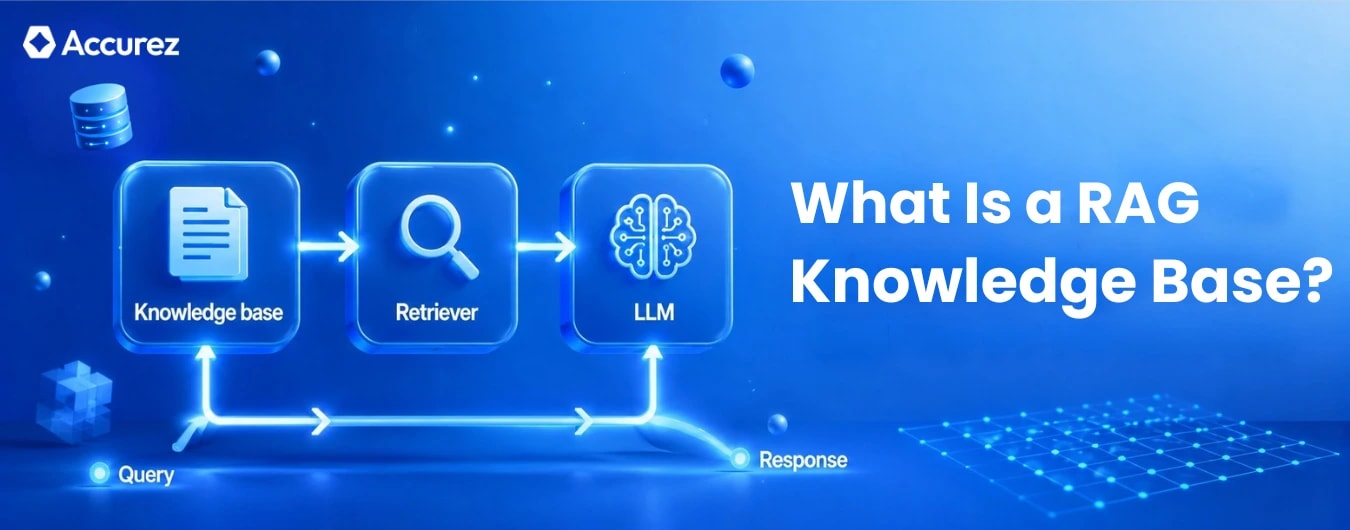
RAG stands for Retrieval-Augmented Generation. When a user asks a question, the system does not hand it straight to the language model. It first searches a knowledge base for content relevant to that question, then passes that content - as context - to the model alongside the original question. The model generates a response grounded in what was retrieved, not just in what it was trained on.
One thing worth understanding early: the model only sees what the retriever surfaces. If the retriever pulls back the wrong chunks, the model generates its answer from the wrong context. Answer quality is bounded by retrieval quality - which is why knowledge base structure matters more than most people expect.
Where the knowledge base fits in the RAG pipeline
The knowledge base is the source the retriever searches. It contains your documents, policies, guides, and product information - whatever your AI system needs to answer questions accurately. Before any of that content can be searched, it goes through a preparation process: text gets split into chunks, chunks get converted into embeddings, and embeddings get stored in a vector database the retriever can query.
As AWS confirmed in its RAG documentation, RAG output quality depends entirely on the quality and reliability of the underlying knowledge source. A well-maintained knowledge base produces reliable answers. An ungoverned one full of outdated documents produces confident wrong ones. The model is almost secondary.
RAG vs standard LLM - why external knowledge changes everything
A standard LLM works from its training data only - a fixed snapshot with a cutoff date. It cannot know about your organization's internal information unless that somehow appeared in its training set.
RAG connects the model to a live knowledge base you control. Answers reflect current data, not a training snapshot. It also costs far less than fine-tuning, which rewrites the model itself - RAG just changes what the model can see.
One honest caveat - RAG does not fix a bad knowledge base. If your content is incorrect or outdated, the model uses it confidently. Whether the content is reliable is entirely your responsibility.
How to build a RAG knowledge base
Define your domain and map user questions first
Before importing a single document, answer this question: what specific questions does this system need to answer, and what does the person asking them actually know? That determines your content scope, category structure, and how you prepare source documents.
A RAG system without this step contains everything and answers nothing well. Too broad floods the retriever with noise. Too narrow sends users into dead ends. Define the boundary first.
Collect, clean, and validate your source data
Before any document goes into the knowledge base, it needs to be accurate, current, and free of contradictions. Two documents saying opposite things about the same policy produce inconsistent answers. An outdated procedure produces answers that were correct two years ago.
The temptation is to clean data later, after seeing what the system produces. That is the wrong order. Duplicate documents create retrieval noise. Unverified time-sensitive content leaves incorrect guidance live in the index. A document that ends mid-sentence produces an answer that trails off exactly where the user needed the explanation. Clean before you index.
Chunk your data for retrieval accuracy
Chunking is splitting your documents into smaller pieces before indexing them. This is where most RAG pipelines quietly fail. If your chunks are too large, the retriever pulls back more context than the model can use well, which dilutes the relevant signal. If chunks are too small, you break the semantic continuity that makes a passage useful as context.
The confirmed practical range for knowledge base content is 512 to 1,024 tokens per chunk with 128 tokens of overlap. The overlap prevents you from splitting an idea at a boundary where it loses meaning. Aim for chunks that can answer one question on their own.
Generate embeddings and vectorize your content
An embedding is a numerical representation of text that captures meaning rather than exact words. Two sentences that mean the same thing get similar embeddings, which is what makes semantic search work - finding content that matches the meaning of a query even when the words differ.
Every chunk goes through an embedding model that converts it into a vector representing its meaning. The model you choose matters because different models perform better on different content types.
Store and index in a vector database
A vector database stores your embeddings and makes them searchable. A query gets converted into an embedding, and the database returns the stored chunks with the closest matching embeddings - the most semantically similar content to the question.
Common options include Pinecone, Weaviate, Qdrant, Milvus, and Chroma. For organizations handling sensitive data, self-hosted vector databases keep indexed content inside your own environment.
Similarity search and metadata filtering - how retrieval works
When a query arrives, the retriever converts it into an embedding and searches for stored vectors with the smallest distance - measured by cosine similarity.
Metadata filtering adds a second layer of precision. Rather than searching the entire knowledge base for every query, you filter by category, date, department, or access level before similarity search runs. A query about a specific product filters to that product's documentation only. Metadata filtering is what makes large knowledge bases practical rather than noisy.
What makes a RAG knowledge base perform well
Content quality and source reliability
The single biggest determinant of RAG output quality is not the model. It is knowledge base content quality. Verified, current content produces accurate answers. Unverified or contradictory content produces confident wrong ones.
Every source document needs a verified accuracy date, a clear scope statement, and a named owner to contact when content is questioned. Without those three, you have no way to know whether what the system retrieved is current or who to ask when it is wrong.
Chunking strategy and retrieval precision
The chunking decisions made during ingestion directly determine retrieval precision. Too long and relevant content gets buried in noise. Too short and the answer loses the context that makes it complete.
Test your chunking before deploying. Run a set of real queries and check whether the retrieved chunks contain the answers. Adjust before users encounter the problem.
Keeping the knowledge base updated
An answer from a deprecated procedure will be wrong and delivered with the same confidence as a correct one. Users cannot tell the difference unless the system shows its source.
Every document needs a review date set before it goes live, and a system that flags it automatically when that date passes. High-turnover content needs quarterly reviews. Stable reference content can tolerate annual cycles. Assign a named owner for each document - shared team responsibility reliably becomes nobody's priority.
Avoiding hallucination through clean data governance
Hallucination in a RAG system is not random. It happens when retrieved context does not contain an answer and the model fills the gap, when contradictory documents give conflicting signals, and when poor chunk structure forces the model to infer from incomplete context.
Every answer should cite its source so users can verify rather than accept passively. High-stakes content should require human approval before becoming authoritative. And when a document is superseded, the old version must not remain indexed alongside the new one.
Most of these governance problems follow patterns that appear consistently across knowledge management implementations - our breakdown of common knowledge management challenges covers why they happen and how to fix them systematically.
Build your RAG knowledge base with Accurez
How Accurez structures knowledge for RAG
Accurez is AI knowledge base software built for organizations where knowledge management and RAG retrieval need to work together.
If you are still evaluating which type of knowledge management system fits your organization before committing to a RAG architecture, our guide on types of knowledge management systems covers how each one works and what it is best suited for.
Content is organized by domain, tagged for precise filtering, and subject to review workflows with enforced review dates - the governance foundation that makes RAG outputs reliable.
The search layer uses semantic understanding, which means queries return relevant results even when the user's phrasing differs from the source document's language - exactly what a RAG retriever needs to work well.
Privacy-first architecture for sensitive data
Accurez runs on your own servers, which means your knowledge base content, embeddings, and query logs stay entirely within your own infrastructure. For organizations in regulated industries, self-hosted deployment is the only architecture that meets the requirement - most cloud-hosted RAG platforms send data outside your environment the moment a query is processed.
Self-hosted deployment also means your proprietary knowledge does not become training data for anyone else's model.
Getting started with Accurez
The knowledge base layer of a RAG pipeline is where most of the real work happens, and most of the failures occur. Accurez handles that layer: document ingestion, metadata tagging, semantic search, content governance, and access control - built specifically for organizations that need retrieval to work reliably, not just document storage to work at scale.
If you need a self-hosted knowledge base structured for retrieval accuracy and governance, explore Accurez AI knowledge base software - book a demo and we will walk you through it.
Get instant answers from your documents
Conclusion
RAG is simple in concept. Connect an LLM to an external knowledge source, retrieve relevant content before generating, and the model works from your data rather than its training. Execution is where most implementations run into trouble.
The most consistent failure point is not the model and not the retrieval algorithm. It is the content - whether it is accurate, current, and governed by people accountable for keeping it that way.
Build the knowledge base right first. Everything else in the RAG pipeline is downstream of it.

Mohamed Nizamudeen
Mohamed Nizamudeen writes about AI and knowledge management, with a focus on RAG systems and how businesses use them to build smarter knowledge bases. He writes for business owners and product teams who want to understand how modern knowledge bases work and how to get the most out of them.
Get instant answers from your documents
See Accurez for yourself
Come with questions and meet the people behind the product.