


Tribal Knowledge vs Institutional Knowledge: The Hidden Risk

Written by: Shushmmitha (Technical Content Writer)
Reviewed by: Sid (Industry Specialist)
Inside the article
Key Takeaways
- Tribal knowledge is undocumented knowledge that exists only in an employee's head. Whereas institutional knowledge is the collective knowledge an organization gains from employees' experience, observation, practical exposure, and other critical skills.
- The key difference between tribal and institutional knowledge is that tribal knowledge is left undocumented, while institutional knowledge is documented.
- Tribal and institutional knowledge are like the two sides of a beam balance; you must preserve both.
Summarise this blog for me
Too busy to read the full article? Get a quick summary in your preferred AI tool.
What is tribal knowledge?
Tribal knowledge is qualitative knowledge an employee holds but doesn't document. Employees gain it through years of experience, observation, hands-on exposure, and personal insights. Tribal knowledge underpins certain organizational responsibilities, such as problem-solving, decision-making, and more.
What is institutional knowledge?
Institutional knowledge is the knowledge an organization accumulates through employees' experience, procedures, cultural values, years of operational experience, historical findings, and more.
It provides a framework for the organization's knowledge assets by combining individual employee knowledge with the organization's years of operation.
Is tribal knowledge part of institutional knowledge?
Yes, tribal knowledge is an integral part of institutional knowledge because it represents undocumented knowledge within the organization. Tribal knowledge is like a pearl inside a shell: it exists within the organization but remains uncovered. It lives in employees' heads and often isn't documented in official records.
What are the key differences between tribal and institutional knowledge?
Real-world examples of tribal knowledge vs institutional knowledge
NASA's approach to turning individual expertise into organizational knowledge
NASA’s chief knowledge officer did a podcast about knowledge sharing and practices that support innovation. In the podcast, he shared that during the Apollo space shuttle era, NASA initiated knowledge transfer to support a major space exploration effort.
The baby boomers' knowledge was left undocumented; it stayed only in their heads. As people age, oral histories are being recorded and transcribed. To capture individual employees' knowledge, NASA used a knowledge shuttle console to record system- and component-level decisions by astronauts, flight directors, and engineers.
This helped NASA preserve tribal employees' knowledge and institutional knowledge.
A Redditor's take on tribal knowledge gaps across industries
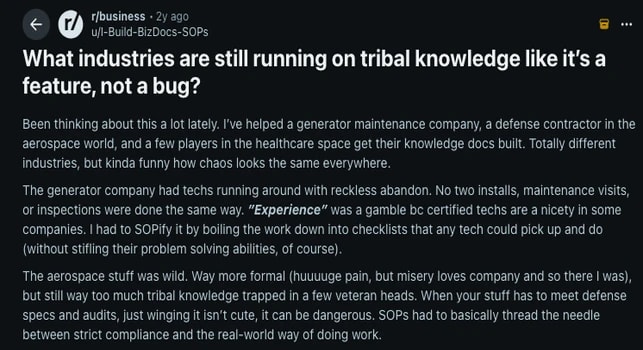
Image source: Reddit
The Redditor highlighted how tribal knowledge was trapped in the head of an experienced employee across multiple industries. It also highlighted how this affects operational workflows and causes delays because employees rely heavily on undocumented knowledge.
How to identify tribal knowledge in your organization
Tribal knowledge can be identified in the following ways:
- Identify tasks that rely on a single employee: Find teams whose workflow depends entirely on one employee, who acts as the sole source of knowledge.
- Identify processes that are left shrouded: Look for hidden or undocumented processes that have been buried over the years.
- Conduct knowledge assessments for veterans: Conduct intensive knowledge assessments for experienced employees to uncover hidden insights they've left undocumented over the years.
- Look for repeated questions and knowledge gaps: Identify recurring questions left unanswered over time and answers that are trapped in individuals' heads.
- Identify unnoticed workarounds: Find silent workarounds used to accomplish tasks that go unnoticed by checking them against existing SOPs and product guides.
- Analyze knowledge loss risk: Identify critical employees approaching retirement, changing roles, or leaving the organization.
How to turn tribal knowledge into institutional knowledge
Five effective steps convert tribal knowledge into institutional knowledge. The steps include:
Step 1: Capture the tribal knowledge
Capture tribal knowledge that stays in employees' heads. To capture tribal knowledge, hold discussions with senior employees, record them, extract insights, conduct knowledge assessment interviews, and run workshops that give junior employees hands-on experience and direct knowledge transfer from senior colleagues. Hold knowledge transfer sessions regularly.
Step 2: Validate the findings
Validate the captured tribal knowledge before documenting. A subject matter expert can validate it. During validation, confirm whether the knowledge is based on evidence and years of experience, not just intuition. Then cross-verify that the new methodology or process derived from the tribal knowledge fits the existing operational workflow.
Step 3: Document the knowledge gained
Set a clear structure for the documentation process, using various formats such as FAQs, how-to articles, product guides, etc. Record videos of senior employees performing practical tasks. Ask them to explain each step so other employees can refer to the recordings when needed. Allocate knowledge managers to oversee the documentation process.
Step 4: Organize and centralize the knowledge
Adopt an effective knowledge management strategy to gather, store, and organize the captured tribal knowledge. Set clear rules for organizing tribal knowledge, such as using metadata and department-based category tags. Use a knowledge base system to centralize knowledge on a single, unified platform.
This makes tribal knowledge easier for junior employees to retrieve when needed; it also secures and preserves it as part of the organization's institutional knowledge asset.
Step 5: Review and update knowledge regularly
Conduct regular knowledge audits from veterans and do a content gap analysis to identify missing content. Document the findings and missing content found during the audit and update it in the knowledge repository. This keeps your overall institutional knowledge up to date and prevents it from becoming outdated.
Get instant answers from your documents
Conclusion
Tribal knowledge is like individual building blocks, each representing an employee's unique experience and expertise. Institutional knowledge brings these blocks together to build a strong foundation that supports the entire organization.
Both tribal knowledge and institutional knowledge are interconnected; neither can be separated. Hence, organizations must take a proactive approach, take balanced steps to maintain stability, and treat them as equally weighted.
How we researched this article
Published research supports the statistics and claims in this article.
Statistics and claims in this article come from these sources.
Written by: Shushmmitha (Technical Content Writer)
Reviewed by: Sid (Industry Specialist)
Get instant answers from your documents
Similar blogs




See Accurez for yourself
Come with questions and meet the people behind the product.