


How to Prevent Knowledge Loss in Organizations

Written by: Shushmmitha (Technical Content Writer)
Reviewed by: Sid (Industry Specialist)
Inside the article
Key Takeaways
- Knowledge loss occurs when valuable information is lost through a single employee, a team, or the organization as a whole.
- Organizations can lose knowledge because of factors such as the loss of tacit knowledge, inadequate risk assessment, ineffective knowledge transfer, and a lack of a structured knowledge management plan.
- A single knowledge holder can be a single point of failure because they carry decades of practical experience.
- Baby boomers serve as pillars of organizational knowledge because they carry knowledge from the organization's early days.
- Strategies to overcome knowledge loss include reducing dependence on individual employees, building a culture of knowledge sharing, implementing a knowledge management system, and conducting regular knowledge audits.
Summarise this blog for me
Too busy to read the full article? Get a quick summary in your preferred AI tool.
Prevention is better than a cure; the best way to retain an organization's knowledge is to take preventive measures against knowledge loss.
It is better to act early to prevent a problem than to deal with its consequences after it happens. In this blog, we'll explore the causes of knowledge loss, strategies to overcome it, and the losses an organization incurs when it occurs.
What is knowledge loss in organizations?
Knowledge loss in organizations is the loss, in any form, of knowledge gained by a single employee or the organization as a whole. It can deplete the organization's most valuable knowledge asset. Knowledge loss is like a slow leak in the organization's profit pipeline; therefore, the organization needs to act proactively.
What leads to knowledge loss in organizations?
Loss of tacit knowledge when employees leave
Tacit knowledge is one of the most important resources of the organization's intellectual capital. It is difficult to document, so a single individual often hoards it. Consider the impact when that individual leaves the organization; it can affect the organization's overall knowledge.
For example, if the senior sales manager leaves the company, the knowledge gained through years of experience handling clients, conducting sales negotiations, and onboarding customers goes with them. In that case, the organization loses out.
Lack of knowledge loss risk assessments
Knowledge loss risk assessment evaluates teams across the organization based on their knowledge. The assessment includes identifying teams where knowledge is stagnant and a single person holds all the knowledge. This helps to locate where critical knowledge lives and uncover buried, unnoticed information.
The knowledge risk assessment outcome can support succession planning. If organizations can't conduct a knowledge assessment, they may fail to map the current knowledge landscape and identify where knowledge gaps are concentrated.
Poor knowledge transfer processes
Knowledge transfer is an important preventive measure against critical knowledge loss in the organization. If the organization fails to transfer knowledge, it can adversely affect knowledge gain for the organization and individual employees.
For example, if a senior system analyst leaves the organization without transferring their knowledge to a junior analyst, the junior analyst may be unsure how to collect business requirements and coordinate with stakeholders.
Here, an individual employee stands out by not sharing knowledge, causing organizational knowledge loss.
Lack of a structured knowledge management plan
A knowledge management plan acts as a blueprint for the organization's knowledge landscape. It helps identify and manage knowledge sources, transfer channels, collaboration media, and dissemination strategies.
If the organization does not put a knowledge management plan into practice, it can lead to information silo, accumulation of outdated information, lack of knowledge sharing, increased time to retrieve information, and increased risk of duplicate work.
Could one knowledge holder become your organization’s single point of failure?
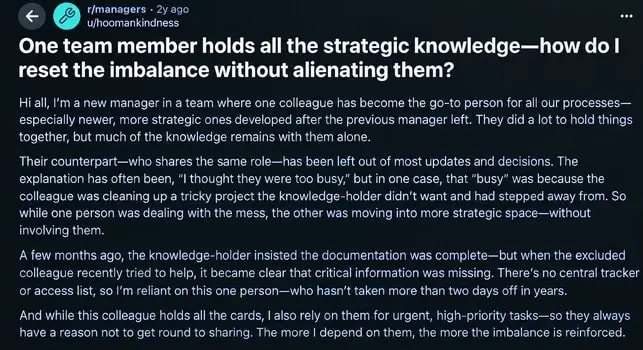
Image source: Reddit
In the Reddit discussion above, the organization's new manager has shared the problem of a single colleague holding all the critical knowledge. The Redditor mentioned that the knowledge holder has started documenting the knowledge, but it isn't fully documented because they've been busy with other tasks. Without a centralized knowledge repository, the manager depends on the individual knowledge holder.
Here, the manager relies on this employee for urgent, high-priority work. Because the employee is constantly needed for urgent tasks, knowledge-sharing keeps getting postponed. When critical knowledge is concentrated in one employee, organizations become dependent on that individual, creating a high risk of single-point failure because the individual acts as the sole source of knowledge.
Is your organization prepared for baby boomer retirements?
Baby boomers are people born between 1946 and 1964. They act as the pillars of knowledge in organizations. They have been integral to the organization since it started. They carry a huge amount of tacit knowledge and can be seen as reservoirs of knowledge, accumulated over decades of experience and practice.
As baby boomers retire, organizations risk losing years of critical knowledge. Knowledge loss is becoming a business risk. Deloitte estimates that baby boomers' retirement-driven loss of institutional knowledge could cost the U.S. $ 6.9–9.6 trillion in economic output.
To retain this knowledge and prevent business loss, organizations can proactively capture it through structured documentation and an AI-powered knowledge management system.
It helps organizations preserve expertise, reduce knowledge gaps, and ensure employees can access critical information even after experienced workers leave.
Strategies to overcome knowledge loss in organizations
Reduce dependency on individual employees for critical knowledge
The following steps can reduce dependency on individual employees for critical knowledge:
- Step 1: Identify employees who are the only or primary sources of critical knowledge.
- Step 2: Create a clear plan for a transparent communication channel between knowledge holders and other employees. Ensure senior employees' instructions reach everyone without restrictions, so everyone gets information and practical knowledge without discrimination.
- Step 3: Give employees who have gained critical knowledge from the knowledge holder a chance to apply it; this helps them gain practical experience.
- Step 4: Document the practical knowledge gained from the senior knowledge holder and the junior who learned it from the senior employee. Compare the critical approaches from both perspectives to identify the knowledge gap and any gaps in practical approaches to completing tasks.
- Step 5: Now turn individual ways of working into repeatable processes, checklists, and guidelines others can follow. This keeps critical knowledge within the organization even when the knowledge holder leaves.
Build a culture of knowledge sharing
Build a knowledge-sharing ecosystem; this makes knowledge a shared organizational asset rather than an individual possession.
Types of knowledge-sharing methodologies are listed below:
- Conduct workshops: Knowledge-sharing workshops act as interactive sessions where experienced employees share their expertise, processes, and lessons learned with colleagues. Record the workshops so that the videos act as a source for your knowledge base.
- Implement mentoring: Allocate experienced employees to less experienced colleagues to transfer practical knowledge.
- Use job shadowing: Let new joiners watch a senior colleague work; this helps them learn how tasks and decisions are handled in practice.
- Encourage peer-to-peer learning: Create peer-to-peer knowledge-sharing opportunities that let employees learn directly from coworkers, which improves the organization's work culture.
- Create SOPs for repeatable processes: SOPs can serve as a resource to train employees on day-to-day processes. They outline procedures for performing a complex task safely and efficiently.
Implement a knowledge management system
Implement a knowledge management system as a central hub for organizational knowledge. The benefits of a knowledge management system are:
- It makes information available across teams instead of getting trapped with a single person.
- Because the KMS acts as a central hub, it serves as a medium for storing scattered information.
- It increases productivity and reduces the time spent searching for information.
- A knowledge management system reduces redundancy in stored information and retrieved knowledge.
Conduct regular knowledge audits
Conduct regular knowledge audits to find outdated, duplicated, inaccurate, or conflicting information and identify knowledge gaps where important information is missing. Content audits help update stale information so employees can rely on current knowledge when making decisions.
The hidden cost of losing organisational knowledge
Higher onboarding and training costs
Losing organizational knowledge increases the cost of training and onboarding new joiners. Training a new employee takes time and money.
Spending more time recreating existing knowledge
If the organization lacks a well-organized source of organizational knowledge, building one from scratch may require additional resources.
Slower decisions and delayed workflows
The organization’s knowledge is often scattered across multiple channels and poorly documented, which slows decision-making it adversely affect the workflow.
Repeating mistakes and inconsistent processes
Organizations lose crucial information and knowledge, increasing the risk of repeated mistakes, and tasks may lack consistent workflows and guidelines.
Poor resource allocation caused by knowledge gaps
Knowledge gaps are a major reason for poor resource allocation. For example, a manager may assign a task to the wrong team because they don't know who has the required expertise. This can cause delays, rework, and unnecessary resource use.
How Accurez helps organisations retain valuable knowledge
Accurez is an AI-powered, self-hosted knowledge base software that lets you store, capture, and organize your organization's knowledge.
Why Accurez:
- It is self-hosted so your knowledge stays within your organization.
- It helps assign dedicated knowledge assistants to each team.
- Knowledge assistants help employees clarify doubts by retrieving information from uploaded documents, reducing dependence on senior employees.
- Using hybrid search, it extracts answers based on the query's context rather than an exact word match.
- Accurez provides grounded answers with source citations.
Get instant answers from your documents
Conclusion
An organization's valuable knowledge is an important business asset. Preserving organizational knowledge doesn't happen overnight; it is like how little drops of water make the mighty ocean. Hence, organizations must take responsibility for maintaining a well-structured knowledge base and make knowledge management an everyday practice.
How we researched this article
Published research supports the statistics and claims in this article.
Statistics and claims in this article come from these sources.
Written by: Shushmmitha (Technical Content Writer)
Reviewed by: Sid (Industry Specialist)
Get instant answers from your documents
Similar blogs




See Accurez for yourself
Come with questions and meet the people behind the product.