


Inside the article
Key Takeaways
- Information silos occur when a specific person, team, or system locks away information.
- An information silo is an isolated or unidentified part of the organization's knowledge. So the organization must break down information silos to preserve the organization's valuable knowledge.
- Information silos stem from multiple factors, such as teams spread across geographies, communication barriers between teams, knowledge hoarding, and a lack of integration.
- There are multiple ways to fix information silos, such as setting clear rules for knowledge sharing, using collaboration tools, and using knowledge base software.
- 57% of IT organizations and teams have improved knowledge sharing with AI.
Summarise this blog for me
Too busy to read the full article? Get a quick summary in your preferred AI tool.
Your organization may have plenty of information, but can your team find the information when they need it?
A process document might sit in a shared drive, a customer review might live in CRM software, and an HR policy might be trapped in an HRM system. Here, the information exists, but it remains scattered across multiple departments, systems, and tools. This is how information gets siloed and creates challenges for modern organizations.
So modern organizations need a solution to break down information silos. And fixing information silo is not about simply putting all the information in one place. It is about creating a connected knowledge-sharing environment where the right people can access reliable information when they need it.
In this blog, let us explore the causes, impacts, and strategies to fix information silos.
What is an information silo?
An information silo is a situation where information is trapped within a particular team or system; sometimes it's even trapped with a particular person. The trapped information is called siloed information. An information silo is more common in organizations where multiple teams collaborate and work together, and information is being shared.
Information can take many forms, including messages, emails, and other physical or digital media. If someone misses a notification, it can create an information silo. An information silo is like a tiny leak becoming a flood; at the initial stage, an information silo can be like a small gap, but it can erode your organization's knowledge.
Why organizations need to break down information silos
Information silos adversely affect organizations. Let us discuss how information silos affect the organization through real-time events within it and why organizations must prioritize breaking information silos.
Lord Darzi's 2024 independent investigation highlighted persistent gaps in information sharing across the NHS. Patient data in England's NHS is often dispersed across disconnected systems used by general practitioners, mental health services, community care centers, and social care. When patients move between providers, their information may not be easily shared, making it difficult for healthcare professionals to access a complete patient record.
To address these gaps, NHS England introduced shared care records, which enable health and care organizations to share key patient information across providers.
What causes information silos in organizations?
Geographic and remote team separation
Consider a multinational company operating globally, both remotely and in physical locations. Because the organization operates differently across locations, it is difficult to share information across the organization.
For example, imagine an MNC with its main office in the US and a remote office in the Netherlands.
The HR team of the main branch has updated the company's employee onboarding policy and stored the latest version in its HR system. However, the HR team in the Netherlands still has the older version of the HR policies and is operating under it. The probation period for a new joinee was 6 months; it was updated to 3 months, but the Netherlands office HR team onboards the employee based on the older policy.
After onboarding the new employee, the HR manager must report the onboarding status to the main branch; at that time, he notices the siloed information. In this scenario, the information was siloed in the HR system, creating a gap in the organization's cross-border functioning.
Communication barriers between teams
Communication between teams is difficult. Each team has its own lane, with no easy road connecting them. When the HR team updates the accidental damage policy in the HRM system, employees must report any accidental damage to company equipment within 24 hours. Depending on the circumstances, the company may cover the repair or replacement costs.
One day in the manufacturing unit, a machine operator caused accidental damage but did not know he had to inform the plant head within 24 hours. The HR team updated the policy, but the information remained siloed in the HRM system, creating gaps in day-to-day operations and inflating organizational resources.
Knowledge hoarding and limited information sharing
Lack of knowledge sharing and knowledge hoarding can create information silos. When a senior employee cannot share their entire valuable knowledge with a new joinee, valuable information stays with the senior employee and is not transferred to the junior employee. This happens because senior employees have many organizational responsibilities; knowledge sharing is only one part, so they cannot transfer 100% of their knowledge.
Disconnected systems and lack of integration
Disconnected systems and lack of integration happen because each team uses dedicated software to meet its needs. For example, the HR department may use an HRM system, the sales team may use CRM software, and the technical team may use code editors. Integrating these systems into a single environment and passing information between them is difficult. In these situations, employees may have to manually transfer data, send files, or contact another team to get the information they need.
How to fix information silos
Set clear rules for sharing and managing information
Organizations must implement clear rules for knowledge sharing and managing information, such as:
- Employees must acknowledge information in any form, such as physical documents, conversations, or digital information.
- Implement role-based information access; not all information should be visible to everyone, and access shouldn't remain unchanged. Update access levels as organizational needs change.
- Assign ownership to keep information up to date; define retention periods.
- Share information only through authorized channels.
Use collaboration tools to improve team communication
Organizations can use collaboration tools such as Microsoft Teams, Slack, and SharePoint to share information and documents across teams. These workspace collaboration tools can help centralize and share information across the entire organization.
Collaboration tools also help teams communicate effectively by creating separate team channels and a centralized channel for sharing information across the organization.
Build cross-functional knowledge-sharing practices
Cross-functional knowledge sharing is an important factor in an organization's smooth functioning. For example, in a large organization, multiple development teams may develop components, but if the knowledge stays within each team, the next team taking over or building the next component can be affected.
To overcome such scenarios, cross-functional knowledge-sharing sessions and meetings are important. After completing the project, each team must document challenges and lessons learned; this helps future teams gain insights.
Use knowledge base software to centralize information
Knowledge base software acts as a centralized repository for holding all the information. Knowledge base software helps prevent information silos because all information in the knowledge base becomes accessible based on the access level.
It helps retrieve and access information as needed based on what we provide. It also helps unify fragmented information, preventing important information from getting buried.
Learn how knowledge management affects decision-making.
How to spot information silos before they become a crisis
Watch for teams that depend on one person for answers
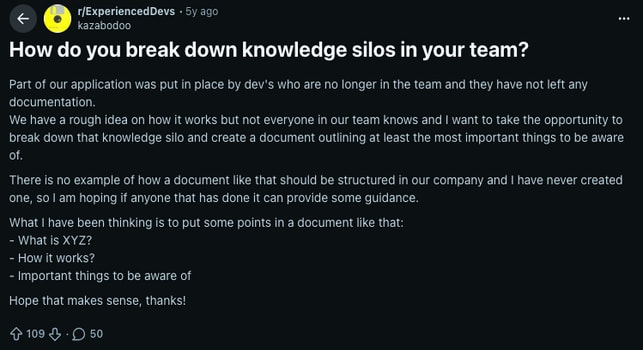
Image source: Reddit
Here, the Redditor talks about a developer who built part of the application but left the organization without documenting how it works. This has siloed the information with the developer who left.
Now, the current team has only a rough understanding. Some people know parts of the system, but nobody has complete knowledge. This delays application development and creates a gap in the organization's operations.
Closely watch teams that depend on a single person for knowledge. If that person leaves the organization, it can significantly disrupt the team's workflow. The organization's regular functioning can be disrupted. This happens because the information gets siloed with that one particular person.
Track recurring questions across teams
If each team member has the same question, they can find the information. Track recurring questions across the team and analyze the reason and root cause behind them. Then find the answer and educate all teams. Tracking recurring questions can help identify organizational gaps in knowledge sharing and management.
Look for bottlenecks caused by restricted information
Look for situations where employees repeatedly have to ask someone else or another department for information before they can continue their work. For example, a sales representative needs the latest product specifications but has to wait for the product team to send the document. This can delay the sales representative from finishing their task.
57% of IT teams see better information sharing with AI
This case study highlights that 57% of IT teams have improved knowledge sharing by using AI, improving communication efficiency across teams. Using AI for knowledge sharing and knowledge management makes information access secure and reliable. Fragmented data hurts organizational scalability, but AI-driven knowledge sharing can reduce data silos and information burying. IT organizations use AI for knowledge management to keep information scalable as they expand.
Learn about the trends defining the future of knowledge management.
How Accurez helps organizations overcome information silos
Accurez is AI knowledge base software that helps organizations centralize information and serve as a central hub.
- It lets you store organizational policies and procedures across teams and retrieve information from uploaded documents. This prevents information silos by providing suitable answers from the uploaded documents; each answer is grounded in a source.
- It also helps organizations collaborate across teams through a single knowledge assistant.
- You can assign each team a dedicated assistant that answers questions using that team's uploaded documents. This can reduce information silos and reliance on a single person as the source of knowledge.
- You can also set access levels for uploaded documents and information retrieved from them.
Get instant answers from your documents
Conclusion
The goal isn't to give employees another place to search. It's to reduce the barrier between people and the information they already need. Before reading this blog, you may have thought of how to break down information silos in your organization. I hope this blog has given you clarity on how to fix information silos in your organization and make its information flow more connected across teams.

Shushmmitha
Shushmmitha writes about AI and knowledge management, focusing on how organizations can capture, organize, and access business knowledge more effectively. Her content helps business and product teams understand practical ways to use modern technology for better knowledge management.
Get instant answers from your documents

See Accurez for yourself
Come with questions and meet the people behind the product.