


Legal knowledge management: Key components, tools, and AI


Written by: Shushmmitha (Technical Content Writer)
Reviewed by: Sid (Industry Specialist)
Inside the article
Key Takeaways
- Legal knowledge management is the process of capturing, documenting, updating, storing, and organizing legal knowledge.
- Legal knowledge is a strategic asset, so law firms have begun managing it systematically with a knowledge management system.
- The key components of legal knowledge management are people, process, technology, tools, and governance.
- AI is changing knowledge management by enabling hybrid search, retrieving knowledge across scattered documents, providing grounded answers with citations, allowing dedicated AI assistants for each team, and governing the AI workflow.
- A legal knowledge management system can be built by locating the firm's knowledge and bringing AI into everyday workflows. After implementing a knowledge management system, measure its ROI.
Summarise this blog for me
Too busy to read the full article? Get a quick summary in your preferred AI tool.
What is legal knowledge management?
Legal knowledge management is the process of capturing, documenting, storing, organizing, and retrieving legal information when needed. In the legal industry, information drives action. Legal teams must balance protecting client information with meeting regulatory requirements.
Each attorney handles multiple cases at a law firm and manages a large volume of information. Traditional legal data management processes fall short, and a modern knowledge management system can replace them.
The real value of legal knowledge management
Legal knowledge management is an important part of legal due diligence. Legal firms hold huge volumes of documents; repositories often scatter them across multiple binders, files, document holders, and filing cabinets, making it hard for legal professionals to find the right information when they need it.
The quality of the institutional knowledge matters because well-structured, properly categorized information is easier for both people and AI systems to retrieve. Legal knowledge is becoming a strategic asset, not just information stored in files and archives.
To uphold this, law firms are increasing their investment in tech knowledge management tools. According to Future Market Insights, the global legaltech market is forecast to cross USD 38.1 billion in 2026 and reach USD 78.1 billion by 2036.
The key components of legal knowledge management
A legal knowledge management system brings five interconnected components together: knowledge and content, people, processes, technology and tools, and governance and policies. Each component supports a different part of legal knowledge management.
Knowledge and content
Legal knowledge management systems connect with various types of knowledge and content. The content documents and knowledge sources may include case files, NDA agreements, lease contracts, lawsuit documents, clause libraries, model documents, and more.
A law firm may also hold undocumented tacit knowledge gained by an attorney over years of experience; this kind of knowledge must be measured and documented to store it in the legal knowledge base.
Once the firm has identified and organized its knowledge, the next step is ensuring the right people can access and contribute to it.
People
Focusing on people in legal knowledge management is essential because employees create, use, update, and share knowledge based on their roles and responsibilities. Paralegals, attorneys, legal assistants, legal researchers, and legal managers are the people involved in legal knowledge management.
For example, an attorney can draft a business agreement between two parties; they may get the template from the knowledge source, while a paralegal may help collect the regulatory requirements from the knowledge source for the agreement; here, we can clearly see multiple employees with different roles accessing the knowledge base and performing actions with it.
Because people use legal knowledge in many ways, firms should establish clear processes to keep the knowledge base reliable.
Process
Legal knowledge management involves a series of processes that determine how knowledge moves through the firm. This includes creating, reviewing, organizing, updating, sharing, and retrieving legal knowledge.
A well-defined process helps prevent outdated or duplicated information from accumulating and ensures that relevant knowledge remains accessible and reliable. Tools and technologies can automate or simplify these processes.
Technology and tools
Think of technology and tools as the engine that powers a legal knowledge management system. Document management systems, knowledge bases, search tools, intranets, collaboration platforms, and AI-powered search are key tools used in legal knowledge management.
A knowledge management system can integrate technologies such as search, LLMs, RBAC (role-based access control), SSO (single sign-on), and databases to help employees find and use relevant knowledge while controlling access to sensitive information.
However, technology alone is not enough. Law firms also need governance and policies to determine how to manage, protect, and maintain their knowledge.
Governance and policies
Knowledge management governance includes maintaining knowledge sources securely and implementing role-based access control. It may include policies for access control, data ownership, document retention, content review, permissions, and information security.
This is particularly important as legal knowledge bases are valuable assets; they contain sensitive information such as client data, case findings, intellectual property, licenses, and other official legal documents.
If any such information leaks from the knowledge management system, it can benefit a competitor and damage the Law firm's reputation.
How AI is changing legal knowledge management
According to a legal industry report, the use of legal-specific AI tools has shifted from 21% to 42%. This shift reflects how AI has dramatically changed legal firms by reducing the workforce needed for manual tasks such as legal research, document drafting, and other legal work.
Search by meaning instead of keywords
Traditional search retrieves answers from the documents by looking for an exact match of the keyword in the query and the document. However, legal professionals often need to find information based on the meaning and context of their question, even when the relevant documents use different wording. Hybrid search combines keyword matching with meaning-based search to find more relevant results.
For example, an attorney may search:
“Find previous cases where a tenant successfully challenged an early termination clause in a commercial lease.”
A keyword search may look for documents containing terms such as “tenant,” “early termination,” and “commercial lease.” Hybrid search can also understand the meaning behind the query and find relevant case judgments, court decisions, legal opinions, pleadings, and other documents even when they use different terms, such as “lease termination” or “tenant’s right to terminate.”
This helps attorneys find relevant legal information without knowing the exact words used in the documents.
Find knowledge across scattered firm documents
A knowledge base helps centralize the scattered law firm documents. For example, a firm's knowledge may be spread across case files, contracts, court judgments, legal opinions, research notes, emails, precedents, pleadings, and internal policies. A knowledge base can bring these sources into a central repository. AI can connect to your knowledge base and help retrieve information faster.
Get answers grounded in firm knowledge
A legal AI knowledge base helps retrieve answers from uploaded documents. Legal answers must be grounded in reliable sources to prevent hallucinations and incorrect legal proceedings.
Grounded answers reduce the risk of basing responses on information missing from the firm's records.
See the source behind every answer
The cited sources act as proof for the grounded answers. Therefore, the legal AI knowledge base provides the exact source it uses to ground the answers. This can also improve the user experience for legal professionals and build trust in the knowledge base. If the answers aren't available in the source, the knowledge management system returns fallback conditions instead of providing incorrect answers.
Give different teams their own AI assistants
Assign each team a separate AI assistant. These dedicated AI assistants provide answers based on the knowledge source each team uploads.
For example, assign the paralegal team a dedicated assistant focused on retrieving basic case details, like the case number. Assign corporate attorneys a dedicated AI assistant to help them find NDA (Non-disclosure agreement) templates and retrieve business contract information.
Govern AI workflows
Remember that clients share their data and case-related information because they trust the law firm, so keep it secure and protected. Think twice before uploading to the knowledge source.
Build a secure workflow that defines AI access to the knowledge source, protects confidential information, requires human review for high-risk tasks, and continuously monitors and updates the system.
How to build a legal knowledge management system
Find where your firm’s knowledge lives
Before building a legal knowledge management system, find multiple areas within your law firm where knowledge is stagnant. Look for physical knowledge sources like binders, physical files, drawers with piles of unpinned papers, and unused case files in cupboards.
Also try to capture the tacit knowledge of the firm's senior attorneys, along with past case findings and court judgments. After capturing it, document it and add it to your knowledge source.
Choose one high-value legal workflow
Pick a repetitive process that requires a lot of legal knowledge, like due diligence, case research, or contract review. Identify the required documents and legal information, pinpoint where lawyers spend time searching or repeating work, and define a measurable outcome.
This provides a focused starting point for building or improving your legal knowledge management system.
Build a knowledge base lawyers can actually search
Your legal knowledge base is for legal professionals; hence, make it user-friendly, as they are not technical experts. For example, while a group of attorneys discusses the strength of the case, a junior attorney can use the knowledge base to retrieve the meritorious claim.
Here, the attorney needs the information immediately; in such cases, a user-friendly, easily accessible knowledge base helps the attorney quickly find the right information for the case.
Bring AI into everyday workflows
Bring your AI knowledge base into the legal firm's day-to-day operations. For example, new joiners and junior attorneys can have a dedicated AI assistant to clear their doubts, saving senior attorneys time they would otherwise spend training juniors.
Ensure that the paralegal team enters case details and client data by documenting and entering them directly into the legal knowledge base.

Image source: Reddit
A legal professional on Reddit discussed how they use AI in their daily workflow and how it has saved them time. They highlighted that they use AI for legal research, drafting, summarising, and outlining, and that it has saved 15-20 hours of working time.
Learn more about how AI is impacting legal professionals.
Govern, train, and improve the system
- Set rules and regulations for who can access the knowledge source; decide whether AI should have full access; and conduct security audits to prevent cyberattacks.
- Regularly review content to identify outdated case law, regulations, and legal templates, and update them with the latest regulations and precedent.
- Train attorneys to access the knowledge management system and conduct AI-supported legal research.
- Monitor AI accuracy, identify unanswered or failed questions and the most frequently searched terms, and update the content accordingly.
- Collect feedback from attorneys to identify missing documents and knowledge gaps. Based on the feedback gathered, address the knowledge gaps.
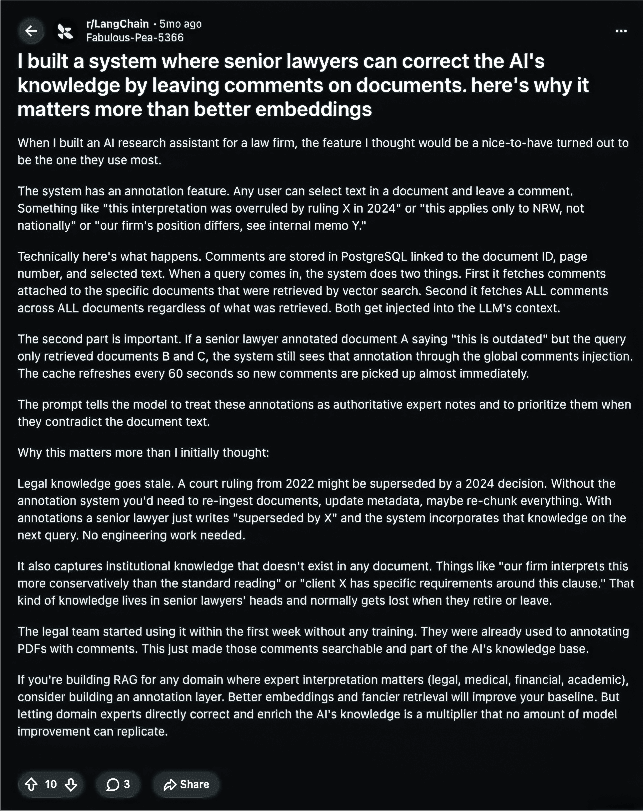
Image source: Reddit
In the Reddit discussion above, the Redditor mentioned that senior lawyers can review and annotate a comment on the knowledge source; this improves the AI outputs, corrects mistakes, and captures useful corrections as reusable knowledge. This shows how AI can improve and train on content to keep it up to date and prevent it from becoming stale.
How to choose legal knowledge management software
Check supported knowledge sources
Before choosing knowledge management software, check which knowledge sources and formats it supports.
This is a basic checklist of the knowledge source formats and types that every legal knowledge management software must have:
Knowledge source formats
Knowledge content types
Evaluate search and AI retrieval
Check whether your knowledge management software supports hybrid search that works beyond traditional search. Because hybrid search retrieves answers based on the question's context, it finds relevant sources beyond exact word matches.
After performing hybrid search and identifying relevant information from the source with AI retrieval, the system generates answers in simple, plain, human-readable language.
Look for evidence and source citations
Ensure your knowledge management system provides answers with sources that ground them. These sources serve as evidence that the answer exists. This is an essential feature of every legal knowledge management system because, in the legal industry, each answer can shape precedent.
Check permissions and confidentiality controls
Check whether the knowledge management system has all necessary security controls. Confirm whether only authorized users can access confidential information. This helps prevent data theft and security breaches.
Confidentiality controls also include a confidentiality score with each answer, which can indicate the accuracy of the retrieved answers.
Make sure the software fits your daily workflow
Make sure the knowledge management software meets the law firm's needs and will support future growth as the firm expands. The knowledge management system should support daily workflows, such as case filings, storing litigation information, accessing client details, and retrieving templates for immediate affidavit drafting.
Compare deployment options
There are various deployment options available, such as:
Cloud deployment: The software runs on the vendor's infrastructure. Law firms can access it through a web browser.
Private cloud deployment: Your knowledge management system runs on a dedicated private cloud environment provided by a third party.
Public cloud: The software is deployed in public cloud providers such as AWS, Microsoft Azure, and Google Cloud.
Self-hosted: The law firm deploys the knowledge management system on its own infrastructure. This gives greater control over data, access, and infrastructure.
If security is your priority, a self-hosted knowledge management system would be the best fit.
How to measure legal knowledge management success
Measure the ROI after implementing the knowledge management system. For example, if an attorney spends 6 hours to find case details, but after implementing a knowledge management system, the time is reduced to 3 hours, the saved 3 hours can be used to attend to a client and gain profit; here, the cost spent on the knowledge management system is compensated by handling additional clients. This generates profit for the law firm and provides a return on investment.
Look into how often attorneys win cases when they use the legal knowledge management system to find case precedents. Also, check how many people use the system and how often the firm reuses knowledge to assess its effectiveness.
Learn more on how to measure knowledge management ROI.
Get instant answers from your documents
Conclusion
Legal knowledge management doesn't come simply from implementing a knowledge management system in your law firm. Attorneys and other legal professionals in the firm must use the knowledge management system in day-to-day operations. When a system runs continuously, we can assess its operational efficiency. Based on its efficiency and user experience, the law firm can make future improvements. I hope this blog has given you a clear insight into legal knowledge management.
How we researched this article
Published research supports the statistics and claims in this article.
Statistics and claims in this article come from these sources.
Futuremarketinsight - https://www.futuremarketinsights.com/reports/legaltech-market
Written by: Shushmmitha (Technical Content Writer)
Reviewed by: Sid (Industry Specialist)
Get instant answers from your documents
Frequently asked questions
Similar blogs






See Accurez for yourself
Come with questions and meet the people behind the product.