


Why Does a Knowledge Management Strategy Really Matter?

Written by: Shushmmitha (Technical Content Writer)
Reviewed by: Sid (Industry Specialist)
Inside the article
Key Takeaways
- A knowledge management strategy is the collective process of capturing, storing, organizing, and retrieving knowledge to drive profitable business outcomes.
- Organizations face economic decline when they ignore knowledge management strategies.
- Effective knowledge management strategies improve business outcomes, enable AI adoption, strengthen governance, integrate knowledge into everyday workflows, and encourage employee participation.
- More than a strategic plan, knowledge management must be treated as an organizational asset that helps to align with the growing knowledge landscape.
Summarise this blog for me
Too busy to read the full article? Get a quick summary in your preferred AI tool.
Introduction
The real value of knowledge lies not in how much an organization possesses but in how effectively it puts that knowledge to use. An effective knowledge management strategy turns organizational knowledge into business profit. In this blog, let's explore the importance of a knowledge management strategy and its impact on the work environment.
Importance of knowledge management strategy: The economic case
What organizations lose every day without one
Organizations get adversely affected in the following ways if they miss the mark on knowledge management strategies:
- Employees' productivity reduction: Employees' productivity declines as they spend more time searching for information, fail to acquire the right knowledge, and disrupt their routine tasks.
- Knowledge disappears with veterans: When a senior or experienced employee retires or leaves the organization, they take the knowledge gained over years of experience with them.
- Slipped away business opportunities: Business opportunities slip away because critical information from previous business-closing decisions is not recorded. Learn more about how knowledge management enhances decision-making.
- Lagging innovation: Since knowledge gets scattered across multiple systems, employees fail to pursue innovation.
- Delayed organizational outcomes: Knowledge is disconnected: some stays in employees' heads, while some is on paper, creating knowledge gaps and delaying organizational outcomes.
- Lack of customer satisfaction: Customers experience delayed responses to queries, and inconsistent service can erode trust and retention.
What practitioners say about the real damage
Real-time insights into missed knowledge management strategies from practitioners and industry experts:
The productivity impact of poor knowledge management
“If only HP knew what HP knows, we would be three times more productive.”
Knowledge loses its value when organizations stop developing it
“Knowledge has to be improved, challenged, and increased constantly, or it vanishes.”
According to Peter Drucker, organisations must treat knowledge as a dynamic asset and continuously improve it in response to the latest changes and trends. Knowledge assessments must identify gaps, and organisations must take measures to keep knowledge current. Without a knowledge management strategy, knowledge can vanish.
6 real importances of knowledge management strategy
1. KM must be embedded in strategy, not treated as a side project
Knowledge management should be treated as a strategic approach rather than a detached workflow. Employees and organizations must view knowledge management as part of everyday work. Deloitte has reported that only 9% of organizations are ready to address knowledge management strategy. The remaining organizations treat knowledge management as software implementation or documentation activities.
This highlights the need for organizations to embed knowledge management into their business strategy through the following approaches:
- Organizations should connect knowledge management with business continuity, workforce productivity, and organizational goals.
- Integrate technology like knowledge base software into a real-time work environment.
- Centralize knowledge resources, involve subject matter experts, organize them so they're easy to find and use, and establish a clear knowledge structure.
- Assign dedicated owners to maintain knowledge; otherwise, information can become outdated or hard to trust.
- Implement effective processes to drive knowledge sharing and measure employee participation and outcomes.
2. KM strategy maturity directly affects business outcomes
Knowledge management strategy maturity cannot be achieved overnight. It takes time and is a gradual process consisting of three maturity levels, listed below:
- Low maturity: This is the initial phase, where knowledge is scattered across emails, documents, and employees' minds. There are no clear knowledge-sharing processes.
- Developing maturity: This is an intermediary phase in which organizations begin to act on knowledge management strategies by documenting information and introducing knowledge-sharing tools and consistent practices.
- High maturity: The final phase where the expected outcome is reached. Knowledge is well-organized, regularly updated, easily accessible, and integrated into everyday workflows.
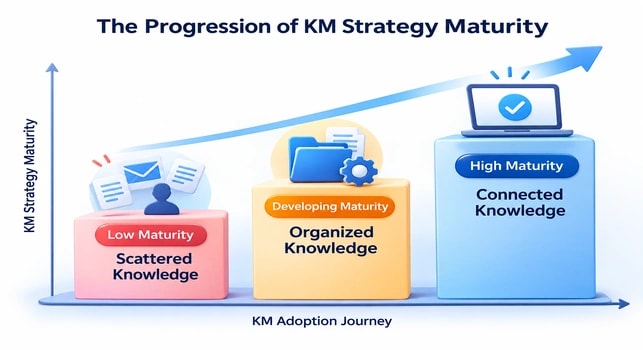
Once organizations reach a higher maturity level, they can achieve significant business profits. But each maturity level in the strategic adoption of knowledge management drives business profit, like little droplets making a mighty ocean.
Learn more about how to measure knowledge management ROI.
3. KM strategy is now an AI prerequisite
A knowledge management strategy is essential to implementing AI in the organization’s workflow. For example, a customer support AI agent may be given a large volume of documents to find answers to the user's queries.
Here is the actual problem: the AI agents digs through hundreds of documents but fails to give the correct answers. This is because the documents are disorganized and uncategorized, making information hard to access. Hence, a knowledge management strategy plays a key role and acts as a baseline for organizing the knowledge base and implementing AI in everyday operations.
4. Leadership treats KM as a tool project, not a capability
KM responsibilities are frequently divided among IT, HR, and other departments, leaving no single leader accountable for its overall success. Simply configuring a knowledge management platform to the work environment cannot drive expected outcomes. Leadership must treat it as an ongoing business capability, assign clear ownership, provide continuous support, and connect KM outcomes with business goals.
5. Governance gaps kill KM programs silently
Organizations often establish effective governance measures at the start of the knowledge management lifecycle but fail to sustain them over time.
This happens for the following reasons:
- Lack of clear ownership: Ownership is often concentrated in a single department, since the knowledge management department oversees it.
- Lack of accountability: Employees often take a laissez-faire approach and assume knowledge management is someone else's responsibility.
- Leadership discontinuity: Disruptions in leadership continuity, for unavoidable reasons, can reduce trust in the knowledge management program.
All the reasons discussed above may seem like a tiny hole in a teapot, but over time, they erode the knowledge poured into the organization. They silently undermine the knowledge management program; eventually, the entire program becomes ineffective.
6. Behavior and adoption are never designed
Organizations focus extensively on creating knowledge rather than changing employee behavior while executing a knowledge management strategy. This happens because organizations often fail to define the behavior they want employees to adopt.
Consider a scenario where a new employee, onboarded a few months ago, was instructed by his manager to perform quality checks. In this case, the manager simply insisted to refer to the SOP and complete the task.
But he still does not know what to do next after reading the SOP. To prevent such situations, define what employees should find and follow in the documented quality-check SOP.
The caveat is that organizations often document information without understanding what employees need to accomplish their tasks. This creates a gap between what employees get from the knowledge resources and what they want to fit into their practical workflows.
How an airline used KM strategy to reduce incidents by 18%
European Airline has integrated knowledge management into its safety management system to strengthen the four pillars: safety policy, risk management, safety assurance, and safety promotion. The KM practices addressed gaps in areas such as stagnant hazard-reporting rates, underreported minor incidents, and lessons learned from investigations.
As a result, operational incidents decreased to 18%.
How Accurez supports your KM strategy
Accurez is self-hosted knowledge base software that can help you achieve your organization’s knowledge management goals.
It has various features that can reinforce knowledge management, such as:
- You can use Accurez as a centralized platform to store all your knowledge resources.
- It finds relevant answers from uploaded documents using hybrid search and returns context-based answers, not just exact keyword matches.
- The answers are grounded with necessary source citations that refer to the exact sources used.
- To reduce friction in applying knowledge from the knowledge resource to actual workflows, assign a dedicated knowledge assistant to each team in the organization.
- Since Accurez is self-hosted it comes with security standards that comply with knowledge governance requirements.
Get instant answers from your documents
Conclusion
A knowledge management strategy is not just a plan to collect information and preserve the organization’s knowledge. More than a strategy, think of it as a framework for gaining profitable outcomes from what the organization already has. It focuses on bridging the gap among employees in managing knowledge resources and on bringing insights into actual workflows.
How we researched this article
Published research supports the statistics and claims in this article.
Statistics and claims in this article come from these sources.
The Business Research Company - https://www.thebusinessresearchcompany.com/report/ai-driven-knowledge-management-system-global-market-report
Written by: Shushmmitha (Technical Content Writer)
Reviewed by: Sid (Industry Specialist)
Get instant answers from your documents
Similar blogs




See Accurez for yourself
Come with questions and meet the people behind the product.