


7 Trends Defining the Future of Knowledge Management in 2026

Inside the article
Key Takeaways
- Employees spend an average of 21 percent of their work time searching for information, and another 14 percent recreating information they could not find in the first place.
- Knowledge workers spend more than a quarter of their day simply searching for information.
- Employees spend an average of 1.8 hours every day just searching for information, and a well-built knowledge system can cut that time by up to 35 percent.
- AI tools are now able to automatically pull meeting summaries, key decisions, and troubleshooting steps straight out of everyday work, without anyone needing to stop and write a report.
- When experienced employees leave, companies lose practical know-how, important relationships, and judgment built from years of experience, none of which exists in any document.
Summarise this blog for me
Too busy to read the full article? Get a quick summary in your preferred AI tool.
In movies like Iron Man, Her, and Interstellar, technology is advanced enough to process information instantly and help people make decisions in real time. Businesses today are still far from that level. Who knows, maybe in the future that could actually become true.
But one thing is already changing fast: companies are moving away from outdated folders and scattered documents toward AI-powered knowledge management systems. These systems can organize information automatically, surface answers faster, and improve collaboration across teams.
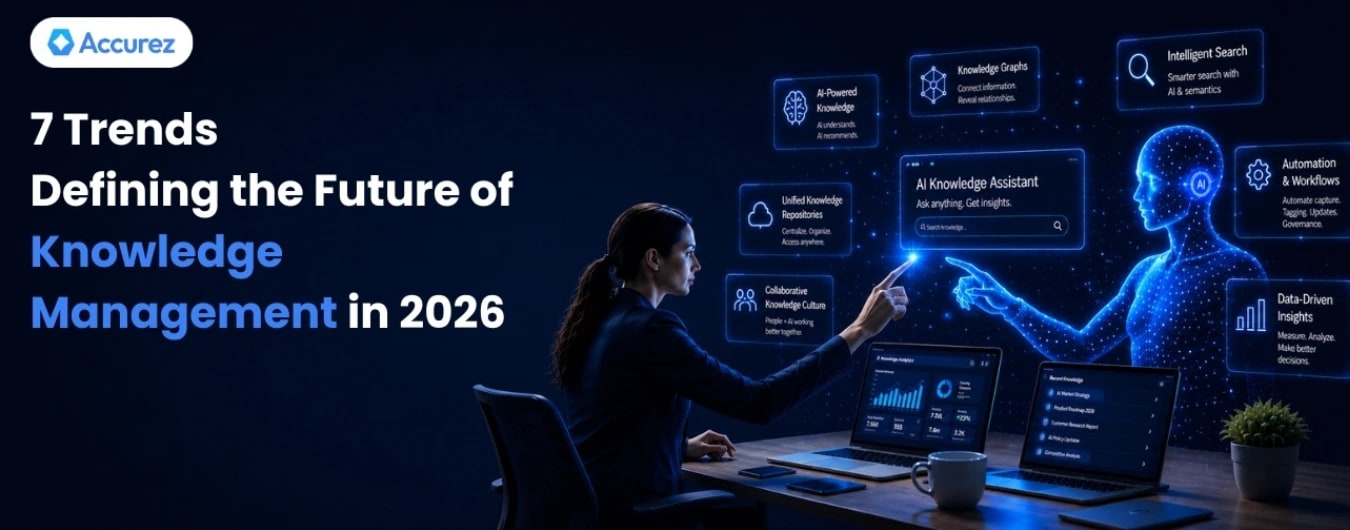
Here are seven trends defining the future of knowledge management in 2026.
7 Trends of knowledge management in 2026
Searching for information feels as easy as asking a friend
Think about how easy it is to find things outside of work. You ask a question and get a clear answer in seconds. Now think about how it feels at work. The same question often means jumping between different platforms, scrolling through messy folders, and eventually just asking a coworker because that's faster.
This gap is a big reason employees stop using company knowledge systems altogether. Harvard Business Review reports that employees spend an average of 21 percent of their work time searching for information, and another 14 percent recreating information they couldn't find in the first place.
What's changing
Workplace tools are finally being held to the same standard as the apps people use every day. Modern systems let employees type a question in plain, everyday language and get a direct answer back. The technology does the searching, the employee just asks.
Where this shows up day to day
Customer service teams give different answers to the same question because two people searched for it and found different things. New employees take longer to get comfortable in their role because they can't find basic process information without interrupting someone else. Experienced employees lose time answering the same repetitive questions over and over. None of these feels like a big deal on their own, but added up across a whole team, they quietly cost a lot of time every week.
The fix
Two things need to happen together. First, the knowledge system needs to live inside tools employees already use daily, like Slack, a CRM, or a help desk tool, instead of being its own separate place nobody remembers to check. Second, the content needs to be organized around the actual questions employees ask, not around how the internal team happens to categorize things internally.
Search that understands what you mean, not just what you typed
Anyone who has spent twenty minutes digging through a company intranet for one document knows the frustration. A traditional keyword search only works if you type the exact same words used in the document. If your wording is even slightly different, you get nothing useful back.
Smarter search fixes this by focusing on the meaning behind a question instead of matching exact words. An employee can ask a question their own way and still get the right answer, even if the original document was written completely differently. McKinsey Research found that knowledge workers spend more than a quarter of their day simply searching for information, which shows how big this problem really is.
Why this matters in real situations
A support agent who can't quickly find the right policy during a live customer call either guesses or puts the customer on hold to ask someone else. A new hire who can't find the onboarding material has to interrupt a senior teammate. A product manager who can't locate an old report ends up redoing research that already exists somewhere. None of these are huge failures by themselves, but they happen constantly across hundreds of employees, and that adds up to a real loss in time and consistency.
The fix
Simply installing a smarter search tool isn't enough on its own. The content itself needs to be written clearly, with titles that match how people naturally think and talk about a topic, not internal jargon. Information should be grouped by what employees actually need, not by how a department organizes its own files. It also helps to track searches that return no results at all, since that usually means the company is missing information it actually needs to create.
Knowledge that stays updated on its own
Every company eventually ends up with old pages in its knowledge base that looked correct when first published but slowly became outdated. Employees come across these pages, assume they're still accurate, and make decisions based on information that's actually years old. Outdated documentation is one of the most common knowledge management challenges, alongside information silos and poor content ownership, making continuous knowledge maintenance essential. Over time, this happens enough that people stop trusting the system altogether.
Why manual checking doesn't really work
Assigning someone to manually check every page for accuracy sounds reasonable, but in practice, this task usually gets skipped the moment things get busy.
The fix
AI-based monitoring tools solve this by making it an ongoing, lightweight process instead of one big, overwhelming project. These tools can flag content that looks outdated, point out missing information, and suggest updates automatically. This shifts the work from large manual audits to small, regular touch-ups.
Knowledge gets captured automatically, without extra effort
Manual documentation has always had the same weakness. It depends on people who are already busy with their main job. The intention to write things down is there, but it keeps getting pushed to later, and later often never comes. As a result, important knowledge stays stuck in people's heads, decisions made in meetings are forgotten once the call ends, and teams end up solving the same problem twice because nobody wrote down how it was solved the first time.
What's changing
Capturing knowledge is becoming something that happens naturally as people work, instead of being an extra task added on top of their job. According to HR Executive, AI tools are now able to automatically pull meeting summaries, key decisions, and troubleshooting steps straight out of everyday work, without anyone needing to stop and write a report. This means the knowledge base keeps growing quietly in the background, reflecting how the company actually works in real time.
Knowledge becomes a core part of how the business runs
For most of the last decade, knowledge management lived in its own little corner of the company. It was owned by one team, used inconsistently by everyone else, and rarely connected to actual business decisions.
What's changing
In 2026, companies are starting to treat knowledge the same way they treat data, technology, or money: as something the entire business depends on, not a nice extra.
In practical terms, this means knowledge becomes part of onboarding, product development, sales, and customer service, instead of being a separate place employees only visit occasionally. The companies doing this well have stopped asking "Is anyone using the knowledge base?" and started asking "Where is knowledge failing to reach the people who actually need it?" and they track the answer using clear performance numbers.
Our guide to building a knowledge management strategy explains how to align people, processes, and technology to make knowledge management part of everyday business operations.
Proving that knowledge management actually pays off
For a long time, knowledge management struggled to justify its own budget because its benefits were hard to put into numbers.
What's changing
That is changing now. McKinsey research shows employees spend an average of 1.8 hours every day just searching for information, and a well-built knowledge system can cut that time by up to 35 percent. Once you convert that saved time into dollars based on average hourly pay, the financial case becomes easy to explain to leadership.
The bigger shift in 2026 is that companies are measuring this regularly instead of just once. They track how often searches succeed, how long it takes to find an answer, whether content stays up to date, and how many people are actively using the system. When leadership sees this data on a regular dashboard next to sales and operations numbers, knowledge management starts being treated as a real business driver instead of a background support task.
Protecting knowledge before experienced employees retire
This last trend is less about technology and more about risk. A large part of the most experienced workforce, especially baby boomers, is approaching retirement. They are carrying decades of knowledge that was never formally written down anywhere.
When these employees leave, companies don't just lose a headcount number. They lose practical know-how, important relationships, and judgment built from years of experience, none of which exists in any document.
The fix
Forward-thinking companies are now treating retirement and departures as moments that require deliberate effort to capture knowledge before it walks out the door. This includes recorded interviews with experienced employees, mentorship-style training, documented decision histories, and using AI tools to pull out knowledge from long-time employees before they leave. Companies that do this well will avoid major disruption as more experienced employees retire over the next several years.
Get instant answers from your documents
Conclusion
The future of knowledge management isn't just about storing information anymore. It's about making knowledge easier to find, easier to share, and more useful in everyday work.
As AI and automation continue to grow, companies that modernize their AI-powered knowledge management systems early will be in a much stronger position to work faster, collaborate better, and adapt more easily in the years ahead.
How we researched this article
Published research supports the statistics and claims in this article.
Statistics and claims in this article come from these sources.
Harvard Business Review - https://hbr.org/sponsored/2025/04/how-knowledge-mismanagement-is-costing-your-company-millions
Similar blogs



See Accurez for yourself
Come with questions and meet the people behind the product.