


Inside the article
Key Takeaways
- This blog discusses six major healthcare data management challenges and real-world scenarios hospitals face in day-to-day operations.
- Poor data management in healthcare organizations affected the pandemic response, leading to delayed intervention and ineffective outbreak detection.
- This blog discusses the consequences of poor data management, such as delayed access to critical information that delays emergency patient treatment, along with other impacts.
- It also explains how modern knowledge management can help overcome data management challenges and help healthcare organizations access their data when needed.
- Accurez is an AI-powered healthcare knowledge base software that simplifies knowledge management and helps retrieve healthcare information from uploaded healthcare-related data and records.
Summarise this blog for me
Too busy to read the full article? Get a quick summary in your preferred AI tool.
Healthcare data must serve as a resource for treating patients; it must not remain an unanswered question. Every medical record, lab report, diagnostic image, and clinical note contains information that supports better decision-making. But when information is scattered across multiple files, outdated, or duplicated, it becomes useless.
So how do healthcare organizations turn fragmented data into useful information?
In this blog, let's look at the challenges in managing healthcare data and practical strategies organizations can use to overcome them.
6 Common challenges in managing healthcare data
1. Data fragmentation and information silos
Data fragmentation is a common challenge in healthcare. Patient data often doesn't stay with a single team or department. Pharmacists, lab technicians, general practitioners, nurses, and other healthcare staff use patient data. Each updates the patient data with additional information; pharmacists update medical bills, and nurses may add monitored vital signs.
If anyone fails to update patient data properly, data fragmentation can occur.
Data fragmentation can create an information silo when;
- A nurse fails to update a patient's vitals, which can then create a silo for a general practitioner.
- A pharmacist fails to update the medical bill; it can create a silo for the insurance claim examiner.
These are some of the common problems that are created due to information silo and can create a gap in the healthcare organization's workflow.
2. Duplicate and inconsistent patient data
According to the National Library of Medicine, duplicate patient records were associated with 44% higher odds of missing an abnormal laboratory result. Duplicate and inconsistent patient data is a major problem in healthcare organizations.
These problems can lead to misdiagnosis, treatment errors, and other issues.
For example, two patients may share the same name, gender, and even age; if their test reports and medication data aren't properly documented, treatment can be confused.
In such cases, duplicate data is likely, and if the healthcare organization fails to keep test reports and medication consistently up to date, patient data may become inconsistent.
3. Difficulty matching patient records across systems
Patient records are often stored and used across multiple systems, like billing software, hospital information systems, and pharmacy management software. If healthcare admin staff record a patient's visit date as 16th of May in the hospital management system due to a medical emergency, and the same patient revisits the next day but the admin fails to update the date to 17th May in the hospital management system.
Still, the pharmacist updates the date to 17th May in the pharmacy management software, which can create confusion when handling patient records.
4. Keeping up with changing regulations and compliance requirements
Healthcare organizations must stay up to date on the latest government regulations. For example, if the government passes a law to digitize patient medical records, the compliance team must find an efficient way to digitize them. If a hospital has been running for 30 years, digitizing medical records can be challenging because of the large volume of data. In such cases, staying up to date with changing regulations and acts can be difficult.
5. Protecting sensitive healthcare data and patient privacy
The patient's data must be protected and kept secure because it is sensitive health information. If a patient is identified with a life-threatening infectious disease, the patient is classified as a biohazard patient; this is sensitive information. If this information leaks outside the healthcare organization, it can frustrate the patient.
However, if the organization does not maintain proper access controls, there is a high risk that information will leave the organization. To address this, the U.S. Congress introduced the Health Insurance Portability and Accountability Act (HIPAA) in 1996.
Under HIPAA, patients' Protected Health Information (PHI) must be protected using role-based access control (RBAC), ensuring that only authorized users can access sensitive health data.
6. Data integration and interoperability across healthcare systems
Healthcare systems often store patient data in different formats, such as PDF, CSV, XML, and other file types. Because of different file formats, it is difficult to export data across multiple healthcare systems.
Data integration can also be difficult if a hospital information system stores the patient's blood pressure as a single "120/80" value while a laboratory information system stores systolic and diastolic readings as separate fields. These differences require data transformation and mapping before healthcare systems can exchange and correctly interpret the information.
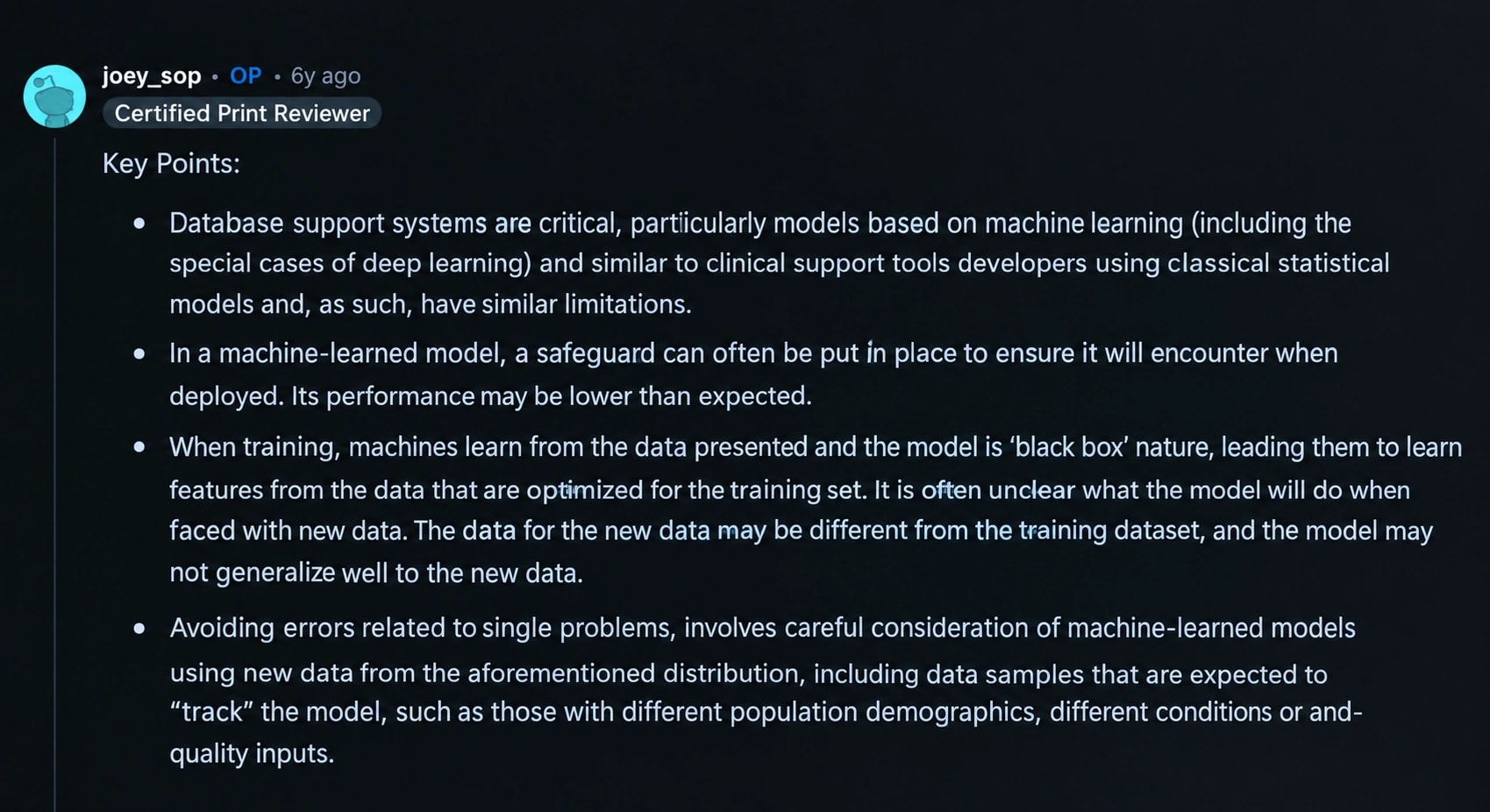
Image source: https://www.reddit.com/r/medicine/comments/pjtkoa/an_in_depth_discussion_of_problems_when_deploying/
The Reddit discussion above clearly shows that training machine learning models on a sample dataset is not enough to achieve the desired results and support clinical decisions. Real-world healthcare data is essential for training machine learning models. But inconsistencies in healthcare data across multiple systems can create gaps when using it to train ML models to make correct decisions.
Did you know:
Fast Healthcare Interoperability Resources (FHIR) is a healthcare data standard developed by HL7 that lets different healthcare applications and systems exchange patient data in a structured, secure way with multiple access levels. Healthcare organizations must implement this standard to ensure interoperability of healthcare data.
Impact of poor healthcare data management during a pandemic
The Health Data Management article clearly emphasizes how improper healthcare data management contributes to infectious disease outbreaks worldwide. The article discusses several causes of poor healthcare data management during a pandemic.
During infectious disease outbreaks like Ebola, coronavirus, or swine flu, healthcare organizations may need to exchange information across hospitals and laboratories. When these systems cannot communicate effectively, healthcare information gets trapped, creating silos.
This slows pandemic response and can increase the number of infected patients. Data fragmentation creates a crisis because the information is unavailable. This delays outbreak detection and early intervention.
The consequences of poor healthcare data management
Delayed access to critical patient information
Poor healthcare data management can delay access to patient information. Consider a patient with chronic kidney disease admitted to a critical care unit. Based on the patient's condition, the nephrologist and urologist advise starting hemodialysis immediately in an emergency ward. Because lab reports were scattered across multiple files, the healthcare staff couldn't find the serum creatinine level. This delays the treatment and can even become a life-threatening problem.
Higher operational costs and resource waste
Poor healthcare data management can increase administrative expenses. Healthcare staff spend more time verifying, retrieving, and correcting patients' information. This reduces staff productivity and can lower the efficiency of resources allocated.
Increased risk of errors in healthcare decisions
If patient healthcare data is not maintained properly, there is a risk of incorrect clinical decisions and incorrect medication. Consider a scenario where a patient's blood test report is misplaced with another patient's; this confuses the hematologist and increases the risk of misdiagnosis and treatment errors.
Disrupted workflows across healthcare teams
Poor healthcare data management can disrupt workflows across healthcare teams. In healthcare, each piece of data is evidence or proof of a patient's underlying medical condition. If any medical data is missed, the entire workflow gets disrupted. If a pharmacist misses a patient billing record, then it can create a gap in the revenue cycle management system.
Reduced quality of patient care and outcomes
Improper healthcare data management can reduce the quality of patient care and desired outcomes. Misdiagnosis or incorrect treatment can delay patients' recovery. This can prolong the patient's hospital stay and delay discharge. Over time, this can erode patients' trust in the healthcare organization, reducing the organization's overall outcomes.
How modern knowledge management can transform healthcare data management
The sections above explain the challenges of managing healthcare data. They also explain the impact of poor healthcare data management. In this section, we explore solutions to the challenges above using a modern knowledge management platform.
To know more about the benefits of knowledge management in healthcare, take a look at this blog "Benefits of knowledge management in healthcare and why it matters."
Brings scattered healthcare knowledge into one centralized environment
Knowledge management platforms help you centralize patient healthcare documents from multiple sources across multiple teams. This makes knowledge management a central hub of healthcare information. For example, the laboratory team, the X-ray team, the HR team, and other teams can store and access healthcare data in a single knowledge base.
Connects healthcare knowledge across teams and systems
The knowledge base connects the healthcare team easily. For example, when a hospital introduces a policy for handling medical test samples, the HR team can easily find it in the knowledge base to educate a new lab technician during onboarding. Even when the laboratory team updates the policy, the knowledge base connects the information across teams.
Makes healthcare information easier to discover and use
The knowledge base makes healthcare information easy to retrieve and use when needed. Because all information is in one place, it's easier to find treatment protocols, SOPs, administration policies, and other healthcare-related data. The knowledge base can also store patient data. This saves healthcare staff time searching for information.
Balances information accessibility with data protection
The knowledge base provides role-based access levels, allowing healthcare staff to retrieve the information they need while protecting sensitive data from unauthorized access. For example, a lab technician may access laboratory procedures and testing guidelines, while a doctor may access relevant clinical information. This ensures employees can quickly find the knowledge they need for their roles while maintaining the confidentiality and security of sensitive healthcare information.
How Accurez makes healthcare knowledge management easier
Healthcare data becomes valuable when healthcare teams can actually use it. Accurez is healthcare knowledge base software that helps healthcare staff retrieve healthcare information. Accurez lets healthcare organizations organize knowledge such as SOPs, hospital guidelines, patient information, and other healthcare records.
Accurez is an AI-powered knowledge base platform that lets you upload healthcare documents and find relevant information within them. Instead of requiring employees to remember exact document names or keywords, users can ask questions in everyday language and retrieve relevant information. Accurez finds information in uploaded documents not only by searching for words but also by matching query context.
Get instant answers from your documents
Conclusion
Before reading this blog, you may have questions about handling healthcare data. I hope this blog has given you all the answers you need. Ultimately, healthcare data should answer questions, not create them. In this blog, we discussed the challenges of healthcare data management and the right approach organizations can use to turn scattered data into useful knowledge that improves healthcare operations.

Shushmmitha
Shushmmitha writes about AI and knowledge management, focusing on how organizations can capture, organize, and access business knowledge more effectively. Her content helps business and product teams understand practical ways to use modern technology for better knowledge management.
Get instant answers from your documents

See Accurez for yourself
Come with questions and meet the people behind the product.