


Inside the article
Key Takeaways
- This blog covers what digital medical records are, their needs, benefits, challenges, etc.
- Traditional paper-based medical records have limitations, including healthcare data theft and other security concerns.
- Digitized medical records play a crucial role in the patient's journey with the healthcare organization.
- The US Navy's initiative to digitize medical records at sea was implemented on USS Carney through the Operational Medicine Care Delivery Platform (OpMed CDP).
- Digitizing medical records starts with choosing the right technology to digitize and organize them and verify the accuracy of digitized medical records.
- Challenges of digitizing medical records include the high cost of digitization, handling large volumes of paper records, integrating with existing systems, and training healthcare staff.
- Accurez is an AI knowledge base platform that helps retrieve information from uploaded medical records.
Summarise this blog for me
Too busy to read the full article? Get a quick summary in your preferred AI tool.
In today's digital world, no one carries physical files or papers in day-to-day life, even to hospitals; everyone carries a mobile phone. People convert papers and binders into digital files for convenience. In this blog, let us explore how digitizing medical records can simplify healthcare operations.
What are digital medical records?
Digital medical records are digitized versions of patient information. These records include patient details, diagnosis reports, prescriptions, lab reports, and treatment history.
The main purpose of digital medical records is to help authorized healthcare professionals share and update the patient's medical history. Medical records may seem like a document or file to most people, but they are a life-saving asset for patients fighting for survival.
The limitations of traditional paper-based medical records
Traditional paper-based medical records have several limitations. These limitations become more pronounced as patient volumes increase or healthcare organizations expand into multiple specialized departments, such as cardiology, hematology, neurology, and other specialties. In these cases, managing traditional paper-based medical records can burden healthcare staff. Some of the hurdles discussed below are sourced from a Reddit discussion.

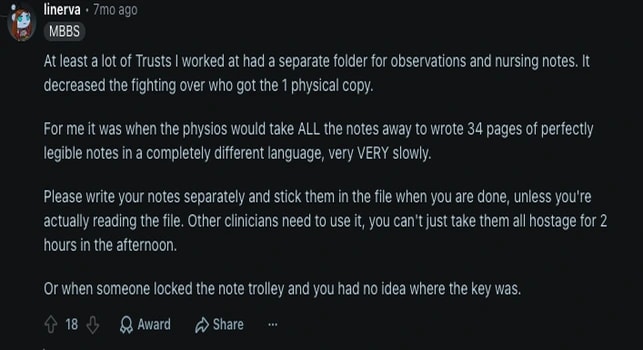
The healthcare staff may face hurdles such as:
- Time-consuming information retrieval - Staff may need to manually search for patients' information across multiple folders, files, and binders.
- Risk of losing records - Records may be lost due to adverse events like fires or other natural disasters.
- Storage requirements - Hospitals or healthcare centers may not have enough space to store a large volume of medical records.
- Security and privacy challenges - Physical records require strict monitoring of who can access, copy, remove, or dispose of them.
- Maintaining patients' information up to date - There is a risk of missing physical charts, misplacing a patient's medical chart with another patient's, or even losing it.
- Single copy of patient medical record - A single-source patient record can create bottlenecks when multiple clinicians need to access or document the same patient's information.
Why patients need digitized medical records
Consolidate medical records from multiple healthcare providers
Patients with severe health complications often need care from multiple healthcare providers. In these cases, the patient's medical records provide valuable data to review their full medical history.
Carrying piles of paper can delay review of the patient's medical history. For these patients, a consolidated, digitized medical record from each healthcare provider can help move treatment forward. They can even use the consolidated medical record to claim their medical insurance for financial needs.
Avoid repeating medical tests due to missing records
If a patient's blood test report is missing, it can complicate diagnosis and medication. The patient must repeat the blood test, which can take time to get the report, and treatment may be delayed. If this happens to a person in a critical care unit, this can be a life-threatening problem. To prevent this, converting paper-based records to electronic health records can be the best solution.
Maintain a complete and continuous medical history
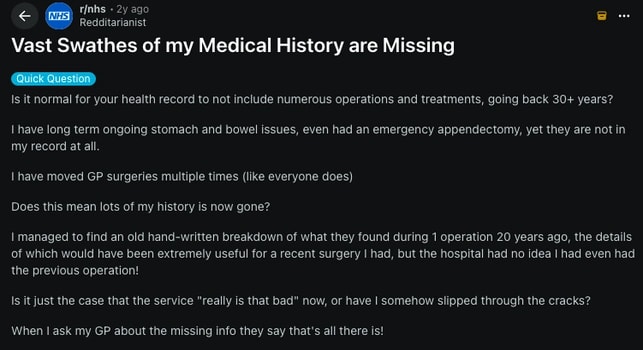
The Reddit thread above clearly shows the need to digitize patients' medical records. When a patient moves from one healthcare provider to another for specialized treatment, they may need their medical history to continue treatment. Medical records are often paper-based and can be lost or misplaced. This can create gaps in care and make it harder for healthcare professionals to treat the patient and achieve the desired outcome. To address this, digitizing medical records can be the best option for storing patients' medical history and ensuring continuous treatment.
How digital medical records keep U.S. Navy healthcare connected at sea
A recent report from TheDefensePost highlights a new U.S. Navy initiative. The U.S. Navy has launched a new initiative to digitize medical records and keep them connected at sea. A US warship, USS Carney, an Arleigh Burke-class guided-missile destroyer, tested the Operational Medicine Care Delivery Platform (OpMed CDP) aboard the ship to replace fragmented paper-based medical records with digital records.
The OpMed CDP was connected with the MH GENESIS military health record system portal. This supports faster clinical decision-making by retrieving patients' medical histories during wartime emergencies. This also improves care for the sailors off the shore.
How to digitize healthcare medical records
Choose the right technology to digitize healthcare records
There are multiple options for digitizing medical records, such as scanning documents into PDF or any other file format.
- Optical Character Recognition can extract text from scanned documents and convert it into machine-readable text.
- Intelligent Character Recognition can extract handwritten text from physical medical records and store it in a digital medical record.
- Other artificial intelligence and machine learning technologies, such as Natural Language Processing, can also help digitize medical records.
Based on your needs, you can select the right technology to digitize the medical records.
Organize and categorize digital medical records
After digitizing medical records, you can categorize them by department or other criteria. Physical folders are difficult to organize and require manual effort; they also require a dedicated storeroom, whereas digital records can be easily organized in a database without needing physical space. Organizing and categorizing digital medical records reduces retrieval time and eliminates time spent searching for data or records.
Verify the accuracy of digitized medical records
Once you store medical records digitally, you must verify them against physical records to confirm accuracy and relevance. Verifying the accuracy of medical records can prevent issues like duplicate data or missing data. Each piece of data in healthcare plays a serious role in helping a patient recover.
Protect digital medical records with secure access controls
Each patient's information and medical history is sensitive information that must not leave the organization. Physical medical records can be stolen easily, which can erode trust between the patient and the healthcare organization. Digital medical records can be secured by providing access levels and login credentials only to the healthcare professionals who need them.
Challenges in digitizing medical records
High costs of digitization and implementation
Implementing medical record digitization is difficult because it requires multiple technologies at each stage. You need specialized tools and technology to scan physical files, convert them into digital files, and store them in dedicated database folders.
Scanning documents and converting them into digital files with OCR and other technologies may increase costs because you may need devices like an optical scanner. Investing in an optical scanner may feel like a burden to budding healthcare organizations.
Converting large volumes of paper records
Consider a healthcare organization that has operated for a decade using paper-based records. When the organization suddenly decides to digitize its medical records, it must digitize thousands of physical records over the past ten to twenty years. In such cases, converting a large number of physical documents into digital documents can take significant time, workforce, and financial resources.
Integrating digital records with existing systems
When a healthcare organization has already begun digital transformation and implemented Hospital Management System (HMS) software, it can move the digitalization process forward by digitizing medical records and integrating them with the existing HMS platform. However, interoperability between digitized medical records and the HMS platform requires further technological development.
Training healthcare staff on new technologies
A healthcare nurse may not have the technical knowledge to retrieve or store the medical record in a database. This can delay the patient's treatment.
To address this, healthcare organizations must train staff during onboarding to use digital medical records. This requires an additional budget for the healthcare organization to train the healthcare staff with the IT team. Some staff can learn the technology quickly, while others may lag. Over time, this can create a knowledge gap in the organization.
Key benefits of digitizing medical records
Reduce paperwork and manual record handling
Digitizing medical records reduces paperwork and manual record handling, lowering the risk of duplicate or misplaced records. It also eliminates the need to carry medical records across multiple teams within the healthcare organization.
For example, when a patient is transferred from the pulmonology department to the oncology department for chemotherapy, staff must carry the papers. Digitized medical records can eliminate this by maintaining all records accessible in a database.
Protect sensitive patient information
Patients' medical records must be kept secure because they are sensitive for both the healthcare organization and the patient. Healthcare professionals must keep treatment protocols confidential and must not let them leave the organization's walls; if a competitor learns them, it can create a major problem. It can even reduce the healthcare organization's profit. Similarly, if a patient's medical record leaks, it can reduce trust in the healthcare organization.
These problems can happen with physical medical records, but digital medical records can eliminate them; multiple access levels can be implemented to access healthcare data.
Share patient information more easily across care teams
Digital medical records make it easy to transfer patient information across healthcare teams. When an orthopedician needs a patient's X-ray report to examine an injured wrist, they can easily find it in the digital medical record instead of waiting for the X-ray team to provide it.
Make medical records easier to back up and recover
When a patient misses a physical medical record, it can delay restarting treatment. Even if the healthcare organization has another copy of the patient's medical record, it can take time to find it manually. A digital medical record solves this problem by storing records across multiple folders and drives, so staff can retrieve them from the hard disk even if the physical copy is lost.
Easier information retrieval from digitized medical records with Accurez
Accurez is an AI-powered healthcare knowledge base platform that helps you find healthcare information from the documents you upload. It can pull details from medical records, staff policies, billing procedures, compliance protocols, infection control guidelines, and onboarding materials.
Since Accurez is self-hosted, everything stays within your organization's own system. Accurez gives grounded answers and shows you exactly where the information comes from. Accurez looks for answers based on the meaning of your question, not just the words you use. You can also sync your medical records from Google Drive. If you want to learn more about how knowledge management can help in healthcare, check out our blog, "Benefits of knowledge management in healthcare".
Get instant answers from your documents
Conclusion
After reading this blog, you have a better understanding of how digitizing medical records can help a healthcare organization run more smoothly. By avoiding physical medical records, a healthcare organization can simplify day-to-day operations. This blog also shows how Accurez, an AI knowledge base, can simplify information retrieval from medical records. With this level of clarity, you can take the next steps toward digitizing your healthcare organization.

Shushmmitha
Shushmmitha writes about AI and knowledge management, focusing on how organizations can capture, organize, and access business knowledge more effectively. Her content helps business and product teams understand practical ways to use modern technology for better knowledge management.
Get instant answers from your documents

See Accurez for yourself
Come with questions and meet the people behind the product.