


Inside the article
Key Takeaways
- 47 percent of healthcare workers report that patients received worse care because staff could not find the correct information when they needed it.
- Hospital workers waste over 65 hours per year searching for information in their systems - time that should be spent on patients.
- A 2025 systematic review of knowledge management in health organizations found that structured knowledge management practices consistently improve care quality and cross-departmental coordination.
- Almost half of managers across health and social care organizations report insufficient knowledge management resources - despite knowledge management being named in their strategic plans.
- For healthcare organizations, data residency and HIPAA compliance are non-negotiable. Self-hosted knowledge management systems keep patient data inside the organization's own infrastructure.
Summarise this blog for me
Too busy to read the full article? Get a quick summary in your preferred AI tool.
Introduction
In most industries, poor knowledge management creates inefficiency. In healthcare, it creates risk. There is a real difference between a sales rep who cannot find the latest pricing sheet and a nurse who cannot find the current drug interaction protocol. One misses a deal. The other misses something that cannot be missed.
Knowledge management in healthcare is the infrastructure that connects the right clinical information to the right person at the right moment. This blog covers what the benefits look like in practice and what to look for in a healthcare knowledge management system.
What is knowledge management in healthcare?
How knowledge management works in a clinical setting
Think about what a clinician at the bedside actually needs. Not a library. The right answer, right now, verified and current. That is what knowledge management delivers in a clinical setting - fast access to protocols, drug references, guidelines, and documented outcomes from similar cases.
A functioning system makes documented knowledge searchable and current. It also makes the right practitioner findable when the answer requires a person rather than a page.
What makes healthcare knowledge management different
Clinical knowledge does not sit still. Guidelines update as new research emerges, drug interaction databases change, and treatment protocols evolve. The knowledge base that was accurate six months ago may now contain information that is not just wrong but clinically dangerous.
An outdated pricing document in a sales organization loses a deal. An outdated clinical protocol causes patient harm. The margin for error is different, and the governance requirements that follow are different too.
Why the stakes are higher than in other industries
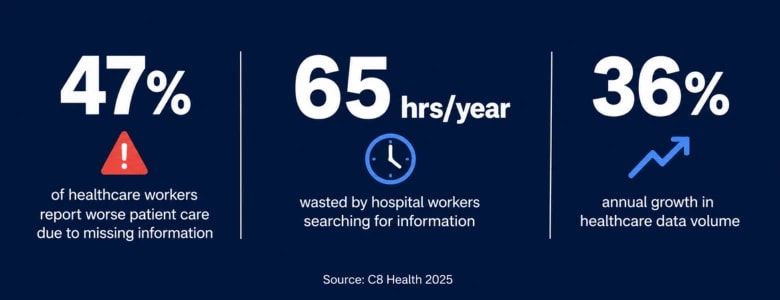
47 percent of healthcare workers report that patients received worse care because it was hard to find correct information. More than half said they had to work late to locate proper clinical guidelines. That is not a technology problem. That is what happens when the wrong information - or no information - reaches a clinician at the wrong moment.
Healthcare data grows at 36 percent annually. Without structured management, that volume becomes noise rather than a resource.
Key benefits of knowledge management in healthcare
Faster and more informed clinical decisions
When a clinician has fast access to current diagnostic protocols and documented outcomes from similar cases, they work with the best available information at the moment of the decision rather than relying solely on recall.
Clinical decision support systems integrated with well-maintained knowledge bases reduce the gap between what evidence-based medicine recommends and what actually happens at the bedside.
Fewer medical errors and safer patient care
Medication errors and protocol gaps are among the most preventable causes of patient harm. Healthcare organizations that have implemented centralized knowledge bases for drug interactions and post-operative protocols report measurable reductions in both medication errors and hospital readmissions. These outcomes reflect what happens when clinical staff access reliable, current guidance at the point of care rather than working from memory or outdated printouts.
Better knowledge access leads to better protocol adherence. Knowledge management does not replace clinical judgment. It gives clinical judgment something reliable to work with.
Better communication and cross-department collaboration
Hospitals are not single organizations. They are collections of departments, specialisms, and shifts coordinating on patient care continuously. A systematic literature review published in the Journal of the Knowledge Economy (2025) found that structured knowledge management practices consistently improve care quality and cross-departmental coordination - with centralized knowledge access identified as a primary driver of better clinical decision-making. A shared repository lets staff across departments access the same protocols, removing the version-control problem that emerges when each team maintains its own documents.
Shift handovers are a particular risk point. A structured knowledge management system ensures incoming teams access the same documented information as outgoing teams, rather than relying on verbal summaries.
Stronger data security and HIPAA compliance
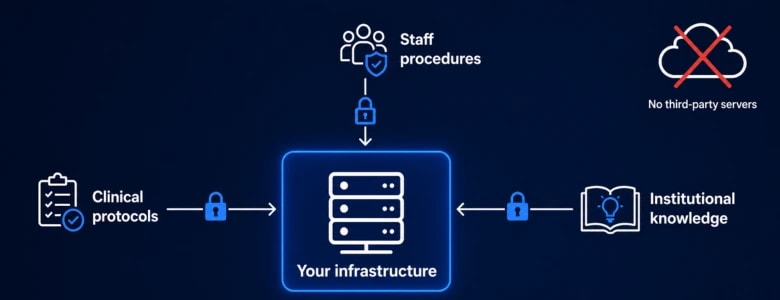
HIPAA requires strict controls over who accesses what information and how it is stored and transmitted - and that requirement extends beyond patient records to any system handling clinical protocols or institutional procedures.
A cloud-hosted knowledge base puts that information on a server your organization does not control. A self-hosted system keeps everything inside your own infrastructure - no third-party access, no data residency uncertainty. For healthcare organizations navigating HIPAA compliance, that distinction matters more than most vendors make clear.
For healthcare organizations managing sensitive clinical knowledge, Accurez is self-hosted AI knowledge base software that keeps your content, access controls, and data entirely within your own infrastructure.
Support for continuous learning and staff development
A knowledge management system that supports staff development means new clinical staff reach competency faster, experienced staff stay current, and institutional knowledge does not disappear when senior practitioners retire. Structured onboarding and accessible knowledge resources redirect time toward patient care rather than searching for information.
Increased operational efficiency
When clinical and administrative staff find what they need without interrupting a colleague or redoing research already done in another department, those hours add up fast. Sixty-five hours per year per worker. At a hospital with 2,000 staff, that is 130,000 hours annually spent not caring for patients.
Less time searching means more time with patients. Faster protocol access means faster treatment decisions. Operational and clinical benefits reinforce each other.
How healthcare organizations use knowledge management
Clinical decision support and protocol access
Clinical decision support (CDS) systems integrated with electronic health records analyze patient data in real time and surface treatment recommendations based on current guidelines. When these systems are connected to a well-maintained knowledge base, they reduce variability in care - ensuring that the protocol a clinician follows reflects the latest evidence rather than the version published three years ago. CDS is one of the most direct applications of knowledge management to patient outcomes.
Onboarding and training new clinical staff
New clinical staff carry their highest knowledge gap risk in the first months of practice. A structured knowledge base gives them a reliable reference without requiring them to interrupt experienced colleagues for every unfamiliar situation.
Structured onboarding reduces variation in what new staff learns and how fast they reach competency.
Patient communication and self-service support
Patient-facing knowledge bases reduce inbound queries, improve patient understanding, and support better self-management after discharge.
Governance and maintenance apply equally here. An outdated discharge instruction a patient follows at home creates the same risk as an outdated protocol followed by a clinician.
What real case studies reveal about knowledge management in healthcare
Strategy alone does not guarantee execution
A qualitative case study of an NHS teaching hospital's knowledge management system rollout, involving interviews with strategic management team members, clinical users, and patients, found that despite theoretical awareness of implementation methodologies, actual execution required ongoing practice and structured communication to succeed. The gap between understanding knowledge management strategy and implementing it reliably was significant. Transparent, structured communication across all stakeholder groups was the factor that most determined whether adoption succeeded.
If you have not yet defined your organization's knowledge management strategy, that decision comes before implementation - our guide on what makes a knowledge management strategy actually work covers where to start.
This finding comes up consistently across healthcare knowledge management research. The technology works. The adoption does not. Healthcare organizations that treat a knowledge management rollout as a software deployment tend to end up with an expensive system that nobody uses. The ones that treat it as an organizational change - with training, communication, and persistent follow-through - are the ones that actually see results.
Why resourcing remains the biggest gap
A cross-sectional study published in the Scandinavian Journal of Caring Sciences (2025) examined knowledge management implementation across six health and social care organizations and found that almost half of managers reported their organizations did not allocate sufficient resources to knowledge management - despite including knowledge management in strategic goals and committing to staff development. Specialized medical care received fewer knowledge management resources than primary care, even though the clinical stakes are often higher. The resourcing gap is the most consistent finding across healthcare knowledge management research.
The implication is practical - a knowledge management strategy without dedicated staff, budget, and governance remains theoretical.
If your team needs to build a financial case to secure that budget, our guide on measuring knowledge management ROI shows how to convert usage metrics into numbers leadership will act on.
Healthcare organizations that treat knowledge management as everyone's responsibility typically find it becomes nobody's priority.
Challenges that make knowledge management hard in healthcare
Information scattered across disconnected systems
Most hospitals run multiple EHR systems alongside separate departmental drives, legacy document repositories, and communication tools that were never designed to talk to each other. Ask a clinical staff member where to find the current venous thromboembolism prophylaxis protocol and the honest answer is often - it depends which system you check. That fragmentation is a search problem masquerading as a content problem.
Regulatory complexity and compliance pressure
HIPAA, Joint Commission standards, and clinical quality frameworks each create specific requirements around information access, retention, and audit trails. A knowledge management system that was not built with these in mind does not just fail compliance. It creates liability.
Low adoption among clinical staff
Clinicians are time-pressed and have very low tolerance for systems that add friction without visible payoff. A knowledge base with poor search or stale content does not get abandoned gradually. It gets abandoned fast, the moment a colleague answers a question faster than the search bar did. Adoption requires the system to be genuinely better than asking a person.
If adoption challenges sound familiar, our breakdown of the most common knowledge management challenges covers why this happens across industries and what actually fixes it
What to look for in a healthcare knowledge management system
Must-have features for clinical environments
- Role-based access control: Clinical staff should see the protocols relevant to their role without accessing sensitive information outside their scope.
- Version control and audit trails: Every update to clinical content must be trackable for regulatory and safety purposes.
- Review workflows: Every article needs a named clinical owner and a review date enforced by the system.
- Integration capability: The knowledge management system must connect with existing EHR and clinical workflows rather than requiring staff to switch context.
AI-powered search and knowledge discovery
Semantic search - which returns results based on meaning rather than exact keywords - is essential because clinicians rarely search using the exact terminology in a document title.
AI-powered gap detection surfaces what staff search for but cannot find - the clearest signal of missing or mislabelled content.
Governance, security, and regulatory readiness
A cloud-hosted knowledge base puts institutional clinical knowledge on a third-party server. A self-hosted system keeps it within the organization's own infrastructure.
A system that cannot enforce review cycles and attribute content to named owners will decay regardless of how secure the infrastructure is.
Get instant answers from your documents
Conclusion
Knowledge management in healthcare is a patient safety investment. When clinical staff find the right protocol in seconds, and departments share one reliable source of truth, the benefits flow directly to care quality.
The organizations that actually see results from healthcare knowledge management share one habit - they treat the knowledge base the way they treat clinical equipment. It needs maintenance, named owners, regular checks, and someone accountable when something is wrong.
If your organization manages sensitive clinical knowledge and cannot afford to send it outside your own infrastructure, explore how AI knowledge base software from Accurez gives you full control over content, access, and data - on your own servers, with no third-party exposure.

Mohamed Nizamudeen
Mohamed Nizamudeen writes about AI and knowledge management, with a focus on RAG systems and how businesses use them to build smarter knowledge bases. He writes for business owners and product teams who want to understand how modern knowledge bases work and how to get the most out of them.
Get instant answers from your documents
See Accurez for yourself
Come with questions and meet the people behind the product.